



Budgeting can feel intimidating, especially if money has become a source of stress, shame, conflict, or confusion. For some people, a budget sounds restrictive, like a list of everything they cannot do. For others, budgeting feels overwhelming because the numbers do not seem to work, the bills keep coming, and the financial pressure feels heavier than the plan.
But for Christians, budgeting is not merely a financial exercise. It is a stewardship practice.
A budget is not just a spreadsheet. It is a way of telling the truth about what God has entrusted to us. It helps us see what is coming in, what is going out, what needs attention, and where our hearts may need wisdom, discipline, contentment, or surrender.
Scripture does not give us a modern budget template with categories and percentages. But it gives us something deeper, a biblical vision for stewardship, wisdom, responsibility, generosity, and trust. A Christian budget begins with the belief that everything belongs to God, and we are called to manage what He has placed in our hands faithfully.
Budgeting Begins With Stewardship
Psalm 24:1 says, “The earth is the Lord’s, and the fullness thereof.” That includes our money, our work, our resources, our time, and our opportunities. We may earn a paycheck, pay bills, and make financial decisions, but we are not ultimate owners. We are stewards.
This changes the purpose of budgeting.
The goal is not to control every dollar so we feel safe. The goal is to manage what belongs to God with wisdom and faithfulness. Budgeting becomes a way of asking, “Lord, how should I use what You have entrusted to me?”
That question moves budgeting out of fear and into discipleship.
A Christian budget should help us live with honesty instead of denial, peace instead of chaos, wisdom instead of impulse, and generosity instead of greed.
Start by Telling the Truth
The first step in budgeting is honesty.
Many people avoid looking closely at their finances because the numbers feel painful. They may not want to see how much debt they have, how much they spend, how little they save, or how many expenses are quietly draining their income. But avoidance does not bring peace. Truth does.
Proverbs 27:23 says, “Know well the condition of your flocks, and give attention to your herds.” In an agricultural world, flocks and herds represented resources, provision, and responsibility. The principle still applies: faithful stewardship requires awareness.
You cannot wisely manage what you refuse to examine.
So the beginning of a Christian budget is not condemnation. It is clarity. Look at your actual income, bills, debt, spending, giving and habits. Not what you wish they were. Not what you hope they become. What they are right now.
Truth is not meant to crush you. It is meant to help you walk in wisdom.
Build Your Budget Around Biblical Priorities
A Christian budget should reflect Christian priorities. This does not mean every believer’s budget will look exactly the same. Families, seasons, incomes, needs, callings, and responsibilities differ. But certain biblical values should shape how Christians think about money.
A biblical budget should make room for provision. Scripture calls us to care for our households and meet real needs. This includes housing, food, transportation, utilities, healthcare, and other necessary responsibilities.
A biblical budget should make room for generosity. Giving is not an afterthought in the Christian life. It is one of the ways we reflect the generous heart of God.
A biblical budget should make room for wisdom. This may include saving, preparing for emergencies, paying down debt, and planning for future responsibilities.
A biblical budget should make room for contentment. Not every desire is a need. Not every purchase is wise. Not every opportunity is from God. Budgeting helps us say no when our hearts are being pulled by comparison, impulse, or pressure.
A biblical budget should also make room for honesty. If we cannot afford something, wisdom invites us to admit it. If debt is growing, wisdom invites us to face it. If spending has become emotional comfort, wisdom invites us to bring that to God.
Budgeting is not just about where money goes. It is about what our decisions reveal.
A Simple Beginner Budget for Christians
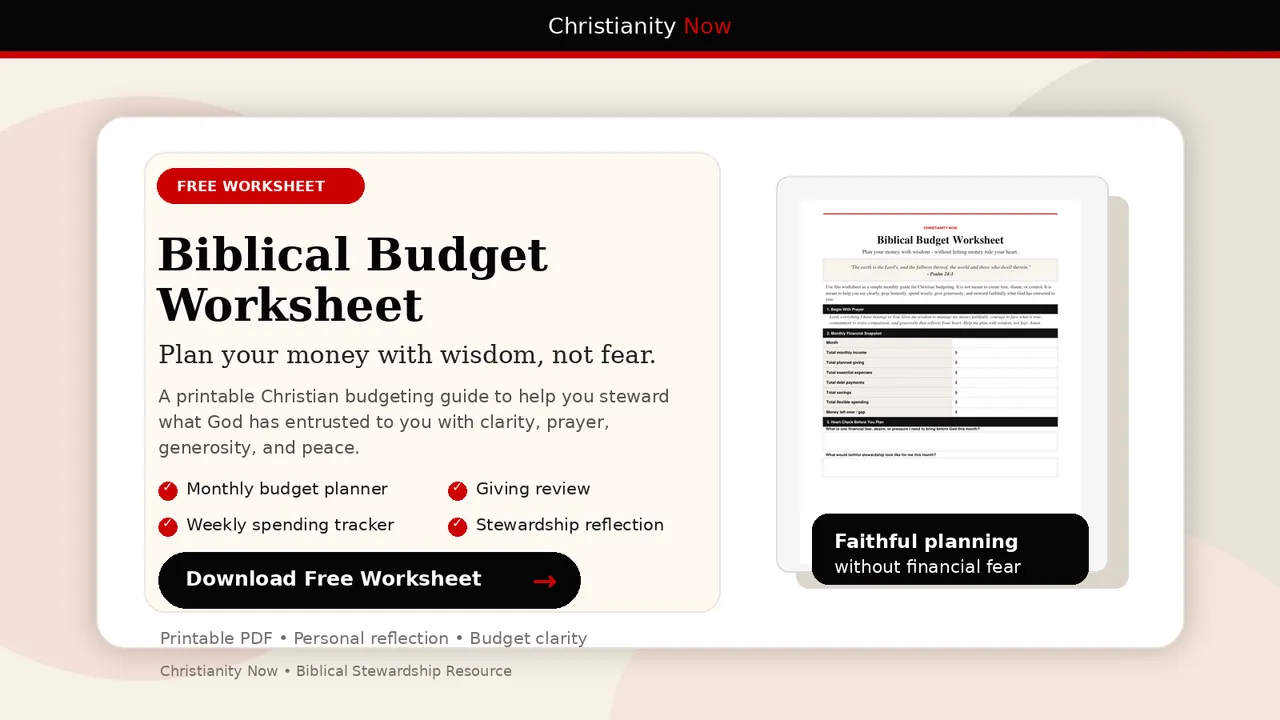
A beginner budget does not have to be complicated. The goal is to create a plan you can actually understand and use.
Start with your monthly income. Write down what you realistically bring home after taxes and deductions.
Then list your necessary expenses. These are the things you must pay to live responsibly: rent or mortgage, utilities, groceries, transportation, insurance, basic household needs, and required payments.
Next, list giving. This may include church giving, missions, helping someone in need, supporting a ministry, or practicing generosity in quiet ways. The point is not to give for appearance or pride, but to build generosity into your financial life as worship.
Then list debt payments. Include credit cards, loans, medical bills, student loans, or any money owed. Debt should not be ignored, even if repayment feels slow. Faithfulness often happens one obedient step at a time.
Then list savings. If possible, begin with even a small emergency fund. Saving is not a lack of faith. Scripture commends wise preparation. The goal is not to hoard out of fear, but to prepare with humility.
Finally, list flexible spending. This includes clothing, household extras, subscriptions, eating out, entertainment, gifts, and other non-essential spending. These areas often reveal where money leaks out unnoticed.
Once everything is listed, compare your income to your expenses. If expenses are greater than income, something needs to change. That may mean cutting expenses, increasing income, asking for help, seeking wise counsel, or creating a debt plan.
A budget is not there to shame you. It is there to show you what is true so you can respond wisely.
Budgeting Helps Reveal the Heart
Jesus said in Matthew 6:21, “For where your treasure is, there your heart will be also.” Money has a way of revealing what we value, fear, love, and pursue.
A budget can become a mirror.
It may show that we are spending more to impress others than to live faithfully. It may show that we are using purchases to soothe anxiety. It may show that we are generous in theory but not in practice. It may show that we are afraid to save because every dollar feels urgent. It may show that we have confused wants with needs.
This is not about guilt. It is about discipleship.
God does not expose the heart to humiliate us. He exposes the heart to heal us. When we see unhealthy patterns, we can bring them before Him. We can ask for wisdom. We can repent where needed. We can invite accountability. We can learn new habits.
A Christian budget is not only about financial order. It is also about spiritual formation.
Budgeting Requires Contentment
One of the hardest parts of budgeting is learning contentment.
We live in a world that constantly tells us we need more: more comfort, more upgrades, more experiences, more convenience, more status, more beauty, more security, more proof that we are doing well. Without contentment, no amount of money feels like enough.
Paul writes in Philippians 4 that he learned to be content in abundance and in need. Contentment was not automatic for him. It was learned through dependence on Christ.
Budgeting helps train contentment because it forces us to make choices. It teaches us that we cannot say yes to everything. It reminds us that financial faithfulness often requires boundaries.
Contentment does not mean ignoring real needs. It does not mean refusing to improve your situation. It does not mean pretending financial hardship is easy. Biblical contentment means our peace is not ruled by what we lack or inflated by what we have.
It means Christ remains our treasure in every season.
Budgeting Should Lead to Peace, Not Control
A budget is a tool, not a savior.
This matters because some people become anxious budgeters. They track every number but still have no peace. They plan carefully but remain controlled by fear. They save responsibly but trust their savings more than God.
Christian budgeting should not lead us into obsession. It should lead us into wise dependence.
James 4 reminds us not to boast about tomorrow as if we control the future. We make plans, but we say, “If the Lord wills.” That posture matters. Christians should plan wisely, but humbly. We should budget carefully, but prayerfully. We should make decisions responsibly, but remember that God is our provider.
The purpose of budgeting is not to eliminate dependence on God. It is to practice faithfulness before God.
What If the Budget Does Not Work?
Some people are doing their best, and the numbers still do not work. That reality should be handled with compassion.
Budgeting cannot fix every financial hardship by itself. Some people need higher income, debt relief, community support, job training, financial counseling, medical help, or emergency assistance. Others are recovering from crisis, loss, divorce, illness, or years without financial guidance.
A Christian response should never be shallow. It is not enough to say, “Just budget better,” when someone is carrying crushing financial pressure.
But even in difficult seasons, budgeting can still help bring clarity. It can show what is urgent, what can be reduced, what help is needed, and what steps can be taken next. It can also help someone pray specifically rather than generally.
God cares about people in financial distress. He sees the single parent stretching groceries. He sees the family behind on bills. He sees the person ashamed of debt. He sees the worker trying to be faithful on limited income.
Budgeting is not a magic solution. But it can be one faithful tool in the hand of someone learning to walk in wisdom.
A Christian Budget Is an Act of Worship
When Christians budget, we are not merely organizing numbers. We are bringing our financial lives under the lordship of Christ.
We are saying, “Lord, this belongs to You.”
We are saying, “Teach me wisdom.”
We are saying, “Help me live honestly.”
We are saying, “Shape my desires.”
We are saying, “Make me generous.”
We are saying, “Free me from fear.”
We are saying, “Help me be faithful with what You have given.”
A Christian budget is not about perfection. It is about surrender and faithfulness. It is a practical way of living out stewardship in ordinary life.
Money will always compete for the heart. But when we bring our finances before God, even budgeting can become part of discipleship.
Key Takeaways
- A Christian budget is a stewardship tool, not merely a financial plan.
- Budgeting begins with honesty about income, expenses, debt, giving, saving, and spending habits.
- A biblical budget should reflect provision, generosity, wisdom, contentment, and responsibility.
- Budgeting can reveal heart issues such as fear, comparison, impulse, greed, or misplaced trust.
- The goal is not control, but faithful management of what God has entrusted to us.
Reflection Questions
- Do I currently know where my money is going each month?
- What does my spending reveal about my priorities, fears, or desires?
- Does my budget reflect generosity, wisdom, and contentment?
- Where do I need to practice more honesty or discipline with money?
- Am I using budgeting as a tool for stewardship, or am I looking to money for security only God can provide?
Prayer
Father,
Thank You for providing for me and entrusting resources into my care. Teach me to see budgeting not as a burden, but as a way to practice wisdom, honesty, and stewardship before You. Help me face my finances with courage instead of fear, humility instead of pride, and faith instead of anxiety.
Give me wisdom to manage what I have, discipline to make faithful choices, contentment to resist comparison, and generosity that reflects Your heart. Where I have made mistakes, help me begin again. Where I feel overwhelmed, remind me that You are near. Let my financial life come under the lordship of Christ, and teach me to honor You with all that You provide.
In Jesus’ name,
Amen.