

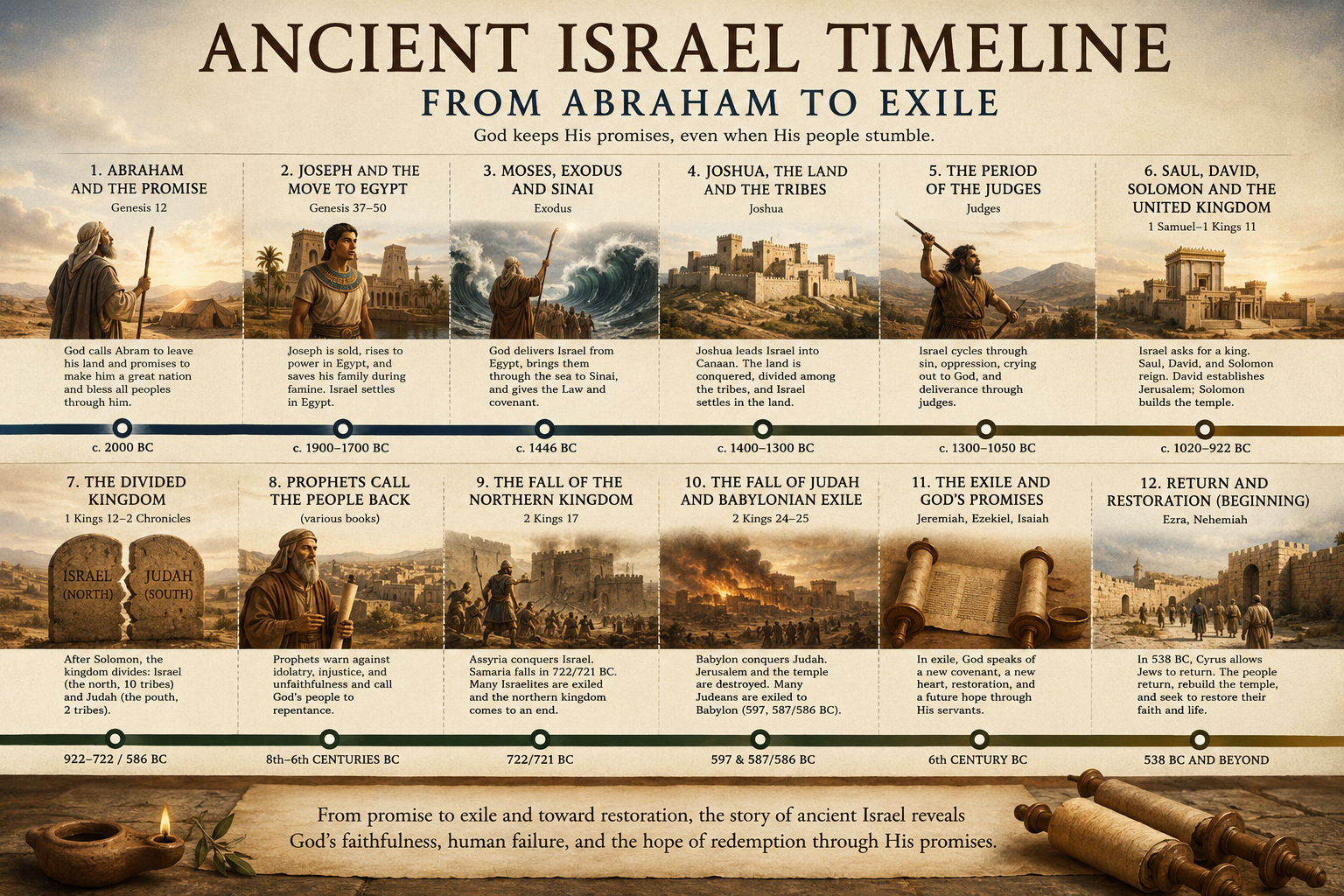
The story of ancient Israel stretches across centuries. It begins with a promise spoken to one man and moves through famine, slavery, deliverance, covenant, wilderness, land, kings, prophets, division, judgment, and exile. It is a long story, but its central thread is clear: God keeps His promises, even when His people stumble.
For many Bible readers, the Old Testament can feel difficult because the names, places, dates, and kingdoms are unfamiliar. Abraham, Moses, Joshua, David, Solomon, Elijah, Isaiah, Jeremiah, Assyria, Babylon, Israel, and Judah can begin to blur together. A timeline helps us see how the story moves.
The goal is not to memorize every date. The goal is to understand the shape of the story.
Abraham and the Promise
The story begins with Abraham, originally called Abram. God called him to leave his country and go to the land God would show him. The promise was astonishing: God would make him into a great nation, bless him, make his name great, and bless all the families of the earth through him (Genesis 12:1–3).
This is where Israel’s story begins, not with a palace, army, or throne, but with God’s promise. Abraham and Sarah were old. They did not have the natural appearance of nation-builders. Yet God promised descendants, land, and blessing.
Abraham’s son Isaac inherited the promise. Isaac’s son Jacob inherited the promise. Jacob was later named Israel, and his sons became the foundation for the tribes of Israel. The Bible connects the twelve tribes to Jacob’s sons and grandsons, making the family structure central to Israel’s identity.
This period is often called the patriarchal period because it centers on Abraham, Isaac, Jacob, and Joseph. The timeline here is not always dated with precision, and Bible readers should be careful not to force exact dates where Scripture itself emphasizes promise, family, covenant, and faith.
Joseph and the Move to Egypt
Jacob’s son Joseph was sold into slavery by his brothers, taken to Egypt, and eventually raised to a position of authority. Through Joseph, God preserved Jacob’s family during famine. What began as betrayal became, by God’s providence, a means of preservation.
Genesis 50:20 captures the theology of Joseph’s story: “You meant evil against me, but God meant it for good.” That sentence becomes one of the great interpretive keys for Israel’s history. Human sin is real. Suffering is real. Yet God is not absent.
Jacob’s family settled in Egypt. Over time, however, the situation changed. A later Pharaoh did not know Joseph, and the Israelites were oppressed. The family that had come to Egypt for survival eventually became an enslaved people crying out for deliverance.
Moses, the Exodus, and Sinai
God raised up Moses to lead Israel out of Egypt. The Exodus became the defining act of deliverance in the Old Testament. God judged Egypt, rescued His people, brought them through the sea, and led them toward Sinai.
The Book of Exodus tells of Israel’s liberation from Egyptian bondage and the Old Testament book that describes the journey to Sinai and the covenant established there.
At Mount Sinai, God gave Israel the law and entered into covenant with them. This moment transformed Israel’s identity. They were not only descendants of Abraham. They were a covenant nation called to live under God’s rule.
The Ten Commandments, the tabernacle instructions, the priesthood, the sacrificial system, and the laws for Israel’s communal life all belong to this covenant setting. These rules shaped Israel as a holy people living before a holy God.
The wilderness years also revealed Israel’s struggle. God provided manna, water, guidance, and protection, but the people repeatedly grumbled, feared, and rebelled. Their journey shows that deliverance from bondage does not automatically produce trust. God had brought Israel out of Egypt, but Egypt still had to be driven out of Israel’s heart.
Joshua, the Land, and the Tribes
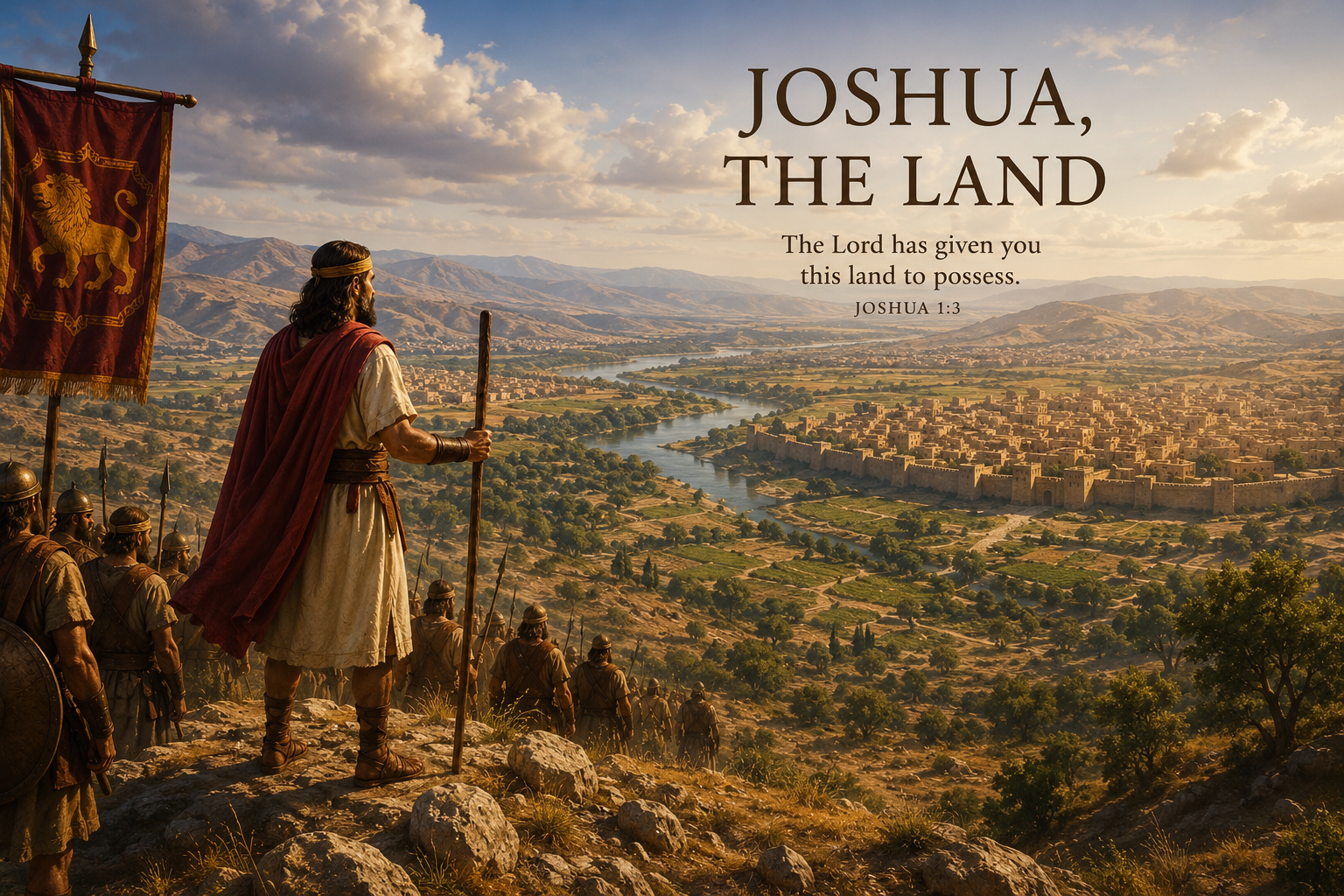
After Moses died, Joshua led Israel into the land of Canaan. Canaan was the land promised to Abraham’s descendants. Canaan is the region identified in the Bible as the Promised Land and notes that Israelite settlement took place in the late second millennium BC, or perhaps earlier.
The book of Joshua tells the story of conquest, settlement, and inheritance. The land was divided among the tribes, and Israel began to live as a people in the land God had promised.
Still, possession of the land did not mean the end of Israel’s spiritual struggle. The people were surrounded by other nations, other gods, and other ways of life. The temptation to compromise would become one of the recurring patterns of Israel’s history.
The Period of the Judges
After Joshua’s generation passed, Israel entered the period of the judges, a season marked by repeated spiritual decline and repeated mercy. Again and again, the people turned from the Lord, experienced oppression, cried out for help, and received deliverance through a judge God raised up.
The book of Judges is difficult because it shows moral and spiritual disorder. The refrain “everyone did that which was right in his own eyes” reveals the deeper problem. Israel had the law of God, but the people often lived by their own desires.
This period teaches that a people can possess religious memory and still drift from faithful obedience. They can know the stories of deliverance and still repeat the patterns of unbelief. The issue was never merely political instability. It was spiritual disorder.
Saul, David, Solomon, and the United Kingdom
Eventually Israel asked for a king making Saul Israel’s first king. David followed him and became the king most closely associated with Jerusalem, covenant promise, and messianic hope. Solomon, David’s son, built the temple.
The united kingdom under Saul, David, and Solomon lasted from about 1020 to 922 BC. This is the period of the united kingdom before the later split between the northern kingdom of Israel and the southern kingdom of Judah.
David’s reign is central to the biblical story because God made a covenant with him. God promised that David’s house and kingdom would endure. This promise becomes one of the most important threads leading to the New Testament and to Jesus Christ, the Son of David.
Solomon’s reign was marked by wisdom, wealth, building projects, and the temple. Yet Solomon’s heart was eventually drawn away by foreign wives and foreign gods. The kingdom looked strong from the outside, but spiritual compromise had already begun to weaken it from within.
The Divided Kingdom
After Solomon’s death, the kingdom divided. The northern kingdom was called Israel. The southern kingdom was called Judah. Israel was associated with the ten northern tribes, while Judah was ruled by the Davidic dynasty and included Judah and Benjamin.
This division matters because many Bible readers assume “Israel” always means the same thing in every Old Testament passage. Sometimes Israel refers to all God’s covenant people. Sometimes it refers specifically to the northern kingdom after the split. Judah refers to the southern kingdom, centered around Jerusalem.
The divided kingdom period was marked by political instability, idolatry, prophetic warning, and occasional reform. Prophets such as Elijah, Elisha, Amos, Hosea, Isaiah, Micah, Jeremiah, and others called the people back to covenant faithfulness.
The prophets did not merely predict the future. They confronted the present. They warned against false worship, injustice, oppression, corrupt leadership, religious hypocrisy, and trust in foreign powers instead of the Lord.
The Fall of the Northern Kingdom
The northern kingdom of Israel eventually fell under Assyrian power, bringing that kingdom’s history to a devastating end. Samaria, its capital city, was captured in 722 or 721 BC after years of prophetic warning and covenant unfaithfulness. In the biblical account, this collapse was not presented as a random political tragedy, but as the consequence of Israel’s persistent rebellion against the Lord. This was a devastating moment. The northern kingdom had repeatedly ignored prophetic warnings. Its fall was presented in Scripture as covenant judgment.
Israel’s fall was severe, but it was not beyond the reach of God’s sovereignty. The prophets continued to speak of restoration, mercy, and a future work of God beyond the ruin Israel had brought upon itself.
The Fall of Judah and the Babylonian Exile
Judah lasted longer than the northern kingdom, but Judah also drifted into sin. Jerusalem remained. The temple remained. The Davidic line remained. Yet these blessings became dangerous when the people treated them as guarantees while refusing repentance.
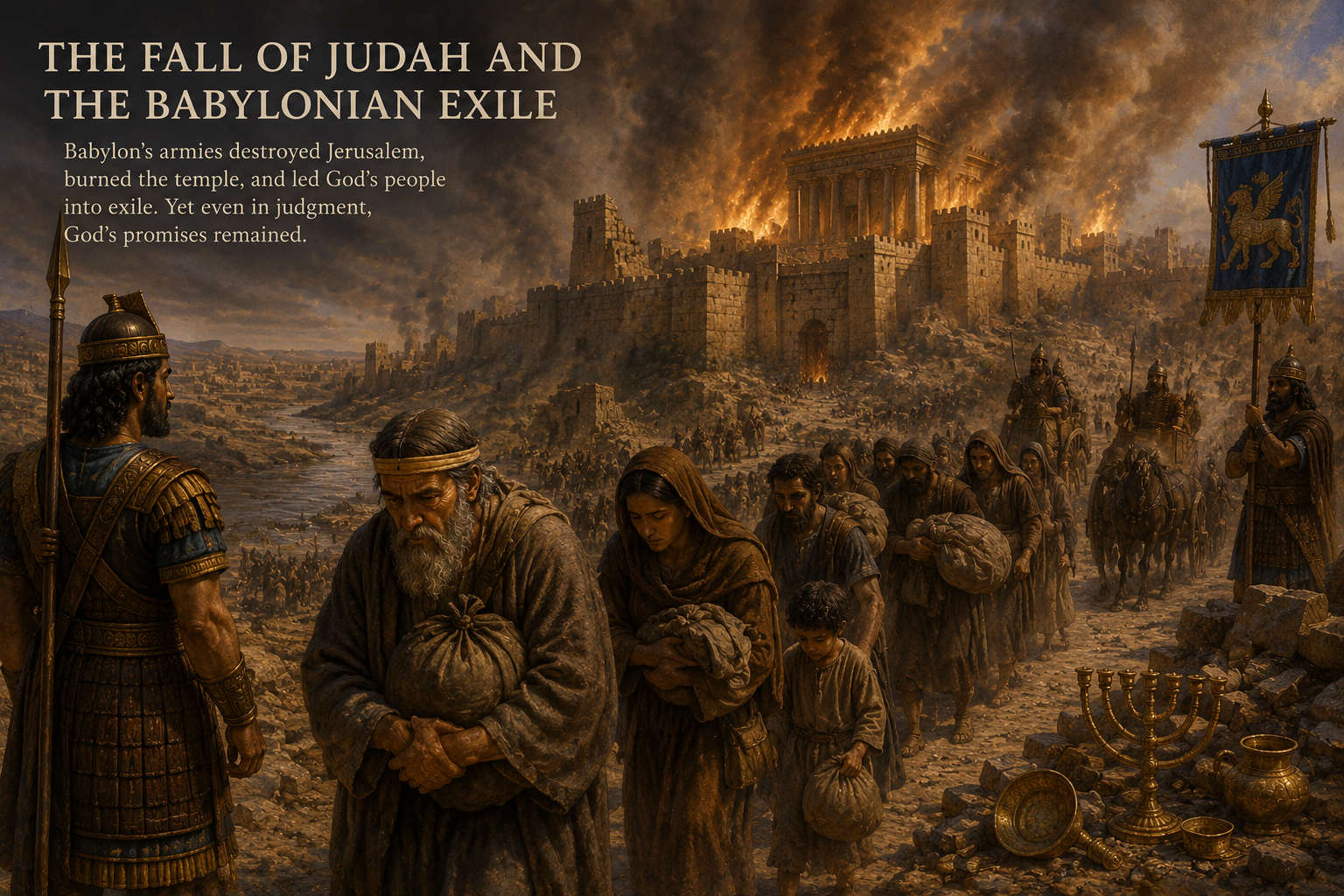
Babylon eventually rose to power. Jerusalem was attacked, the temple was destroyed, and many Judeans were taken into exile. The Babylonian exile included major deportations in 597 and 587 or 586 BC, and the captivity formally ended in 538 BC when Cyrus of Persia permitted Jews to return.
The exile was both historical disaster and spiritual crisis. It raised painful questions. Had God rejected His people? Had the promises failed? Was the house of David finished? Could worship continue without the temple? Could God’s people remain God’s people in a foreign land?
The biblical answer is sobering and hopeful. God had judged His people, but He had not abandoned His covenant. The exile exposed sin, but it did not erase promise.
Jeremiah spoke of a new covenant (Jeremiah 31:31–34). Ezekiel spoke of a new heart and new spirit (Ezekiel 36:26–27). Isaiah spoke of comfort, restoration, and the servant of the Lord. The prophets looked beyond exile toward redemption.
Why This Timeline Matters
The timeline of ancient Israel teaches us how to read the Old Testament as one unfolding story.
Abraham shows us promise.
Moses shows us deliverance and covenant.
Joshua shows us inheritance.
The judges show us human disorder.
David shows us kingship and messianic hope.
Solomon shows us wisdom and the danger of compromise.
The divided kingdom shows us the cost of idolatry.
The prophets show us God’s call to repentance.
The exile shows us judgment.
The promise of restoration shows us hope.
For Christians, this timeline ultimately leads to Jesus. He comes as the promised offspring of Abraham, the Son of David, the true King, the faithful servant, and the mediator of the new covenant. The Old Testament timeline is not merely background information. It is the road leading to Christ.
Ancient Israel’s story is long because God is patient. It is painful because sin is serious. It is hopeful because God is faithful. The timeline does not move in a straight line of human improvement. It moves through promise, failure, mercy, judgment, and redemption.
That is why the exile is not the end of the story. It is a turning point. God’s people lost land, temple, and kingdom, but they did not lose God’s promise. The same God who called Abraham, delivered Israel, warned through the prophets, and judged covenant rebellion would also keep His word.
The story that began with one man under the stars would continue until the promised blessing came not only to Israel, but to all nations through Jesus Christ.