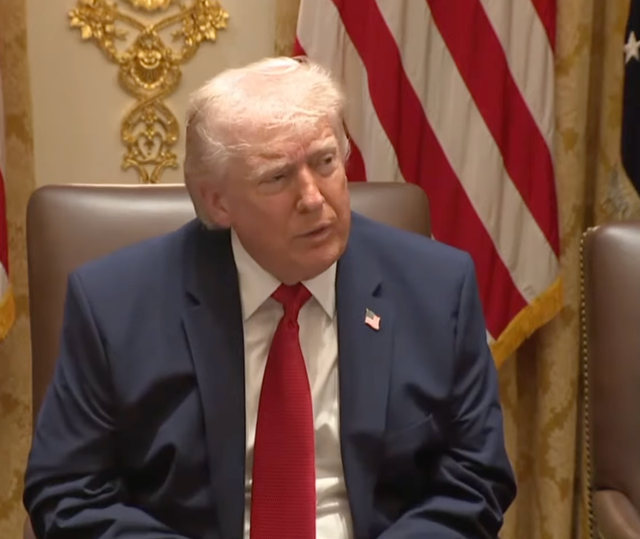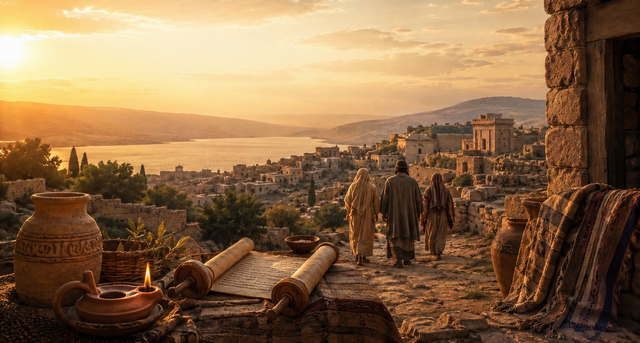


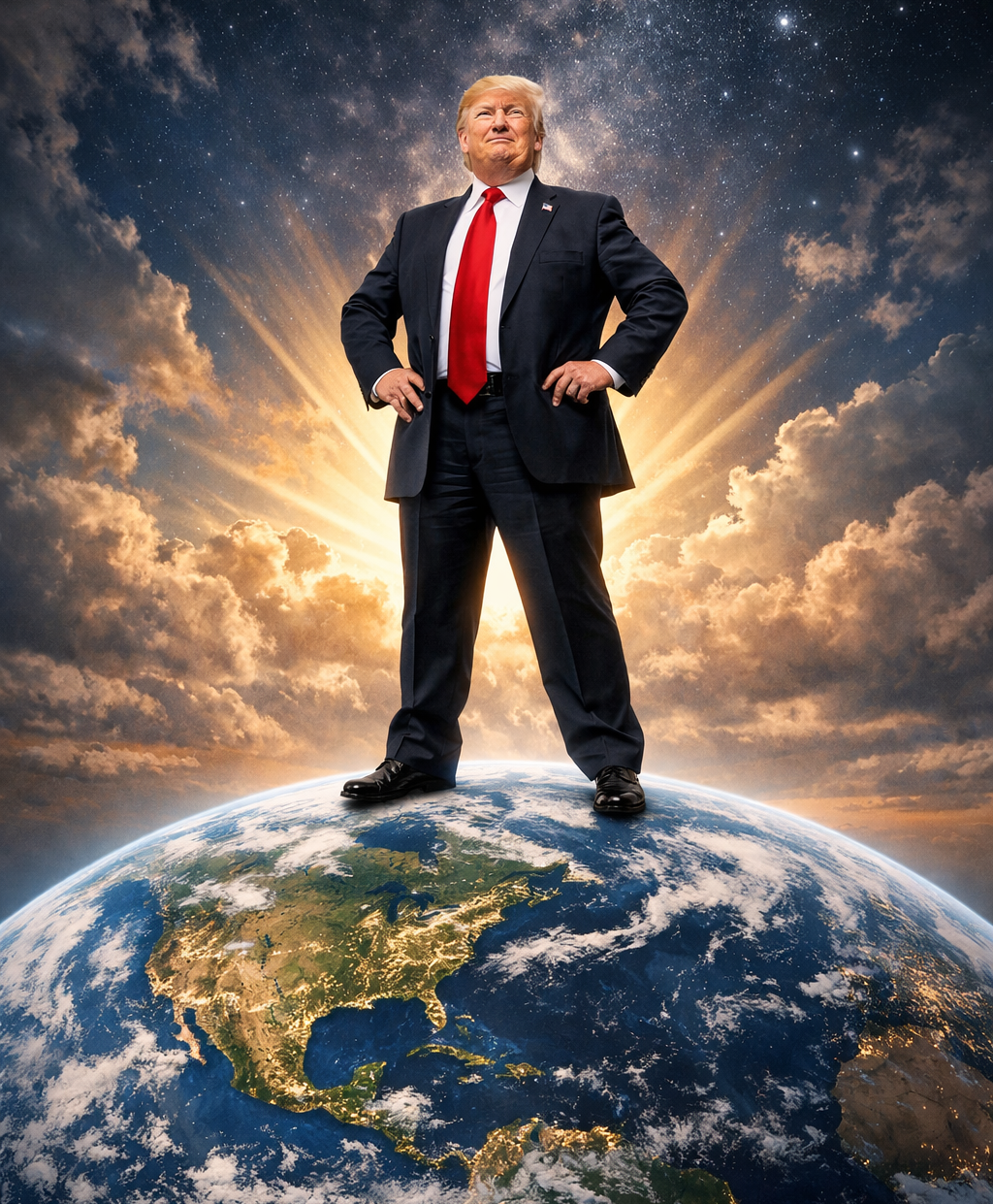
On Sunday, April 12, 2026, Donald Trump posted an AI-generated image of himself in a white robe and red sash, bending over a sick man in a hospital bed, one hand glowing as it touched the man’s forehead. The image looked, to many viewers, less like a physician at work and more like a familiar scene from Christian art. Even some of Trump’s usual religious allies called it blasphemous before the post was deleted the next day. Trump later said it was supposed to show him “as a doctor making people better.” But Christian imagery has a grammar, and this image was speaking it fluently.
The problem, though, did not begin with that image. The image was simply the latest and strangest installment in a political story that has been unfolding for years, one in which Trump’s self-presentation has grown more theatrical, more imperial, and more spiritually charged at the same time that many church leaders have grown either thrilled by it or timid before it. The white robe was not an isolated offense. It was the visible crest of a much older wave of behavior that people, especially religious leaders close to the President and the Republican party choose to ignore.
Trump has always understood politics as performance, branding, and scale. But over the last decade, the performance has moved beyond the usual narcissism of public life into something more liturgical. In March 2024, he began promoting a $59.99 “God Bless the U.S.A. Bible,” a product that fused Scripture with the Constitution, the Bill of Rights, and patriotic symbolism, all under his commercial endorsement. In February 2025, he shared an AI-generated video imagining “Trump Gaza” as a luxury resort complete with a towering golden statue of himself. By late 2025, his name had been added to the facade of the Kennedy Center after the institution was renamed “The Donald J. Trump and The John F. Kennedy Memorial Center for the Performing Arts.” In 2026, his administration pushed ahead with a sweeping makeover of Washington that included a new White House ballroom and a proposed 250-foot triumphal arch with gilded embellishments. The symbolism, taken together, is difficult to miss. This is not merely self-confidence. It is self-monumentalization.
Even the public ceremonies have followed the same pattern. On June 14, 2025, Trump presided over a military parade in Washington that coincided with both the Army’s 250th birthday and his own birthday. The event was framed officially as a national celebration, which included tanks, bands, and troops that moved through the capital on the president’s day. A parade does not become idolatrous merely because a president attends it. But in a political culture already saturated with the language of greatness, destiny, and personal indispensability, such spectacles begin to feel less civic and more courtly.
The church should have been alert to this long before the white robe appeared.
Because what is happening here is not just political excess. It is a spiritual deformation, and one that Christians should recognize immediately. Scripture is unambiguous about glory, sovereignty, and worship. “You shall have no other gods before me,” the Lord says in Exodus 20:3. “I am the Lord; that is my name; my glory I give to no other,” He says in Isaiah 42:8. The church has always confessed that Jesus Christ alone is Lord, not as a poetic phrase but as a direct challenge to every ruler, empire, and personality cult that tries to wrap itself in sacred significance.
That is why Trump’s recent image startled people who still have a functioning religious conscience. It did not simply depict strength. It borrowed visual signals long associated with Christ: the robe, the red sash, the radiant light, the healing gesture, the suffering man beneath his hand. Reuters quoted an art historian who said the image drew from a tradition of Christian art portraying “Christ as healer.” Trump’s explanation that he was just portraying himself as a doctor came after the image had already done its work. It had already asked viewers to see him through borrowed holiness.
But perhaps the more unsettling question is not why Trump posted it. Trump’s history of self-exaltation is so well established that another act of self-mythologizing no longer surprises. The harder question is why so much of the American church has failed to build antibodies against it.
Part of the answer is that the theological groundwork had already been laid for him. In March 2024, Christian media figures were preaching a “messianic message” around Trump, with a pastor saying, “There’s something on President Trump that the enemy fears: It’s called the anointing.” Additionally, Christian broadcasters and prophetic media personalities presented Trump as a persecuted instrument of God’s will. After the assassination attempt in July 2024, many evangelical supporters saw his survival as proof that he was specially protected, even blessed, by God. The language around him had already drifted from providence into myth.
More recently, evangelical leaders have amplified Trump’s religious framing of the war with Iran, portraying it as a struggle between good and evil and linking it to biblical prophecy, Israel, and the Second Coming. The article noted that some evangelical figures compared Trump to biblical heroes such as Esther and, controversially, even Jesus. That is not merely enthusiastic support. It is spiritual inflation. It takes a politician and begins surrounding him with an atmosphere of chosenness so thick that ordinary moral judgment can no longer breathe inside it.
And once that happens, the church’s ability to rebuke him begins to collapse.
You can see the cost of that collapse in the peculiar silence that often settles over the very people who should be speaking most clearly about why this is wrong. The rebukes, when they come, are late and thin. After Trump’s broadside against Pope Leo, some bishops and Catholic leaders did object. Associated Press reported that Archbishop Paul Coakley and Bishop Robert Barron criticized Trump’s remarks as inappropriate and disrespectful. But those moments of resistance have often felt isolated rather than representative, especially when set against the years of photo ops, prophetic flattery, and theological excuse-making that helped normalize the cultic atmosphere in the first place.
The result is a church culture in which the line between intercession and adoration has become perilously thin. Plenty of Christians pray for presidents; Scripture itself commands prayer for rulers. That is not the problem. The problem comes when prayer mutates into devotion, when political loyalty begins to sound like witness, and when a leader’s name enters the emotional space that belongs to Christ alone. The danger is not always formal heresy. Often it arrives as mood, tone, posture, and atmosphere. It arrives when believers begin speaking as though the fate of the church, the nation, and the world rests finally not on the risen Lord but on one strongman with enough force, enough nerve, and enough enemies.
That is why the white-robed image felt so revealing. It made visible what had long been latent.
And it arrived at a moment when Trump’s public conduct had already become harder to separate from imperial fantasy. He has revived threats to take control of Greenland, with renewed pressure on Denmark and Greenland as part of a broader push for Arctic influence. He has escalated and defended a widening war with Iran that has disrupted global markets, darkened the outlook for growth, and contributed to rising energy costs and supply-chain strain. He has publicly attacked Pope Leo for condemning that war and then followed the attack with an image that many Christians immediately recognized as Christ-like. One does not need to believe Trump sees himself literally as divine to recognize that he has become comfortable inhabiting a political imagination in which ordinary limits, moral criticism, and constitutional restraints all appear secondary to his own will.
Congress, meanwhile, has done little to suggest that the party around him intends to stop the escalation. Republicans blocked efforts to force Trump to seek congressional authorization for further military action against Iran. Democrats have kept trying, and just this week, Republicans in both chambers have largely chosen deference. That matters because idolatry is never only a private sin. It reorganizes institutions around a person. It teaches everyone nearby to confuse loyalty with obedience, and obedience with virtue.
For Christians, the biblical conflict here is not subtle. The first commandment still stands. Herod still dies in Acts 12 after receiving the praise of people who shout, “The voice of a god, and not of a man.” Jesus still says, “Whoever exalts himself will be humbled.” The risen Christ still appears in Revelation not as a mascot for any nation’s political movement, but as the Lamb upon the throne. The church’s task has never been to baptize charisma. It has been to tell the truth about power.
And the truth is that no president or public figure can safely inhabit messianic imagery, especially when he has spent years cultivating a movement in which his supporters and allied ministers have already described him in quasi-sacred terms. No leader who sells patriotic Bibles, presides over parades that double as birthday pageants, imagines a golden statue of himself in Gaza, puts his name on public institutions, and attacks religious leaders who rebuke war can be treated as though he is merely another politician with an unusual media style. At some point, self-promotion becomes self-exaltation, and self-exaltation begins to ask for reverence it has no right to receive.
The church should have named that long ago. It should have said that God may use flawed rulers, but that is not the same thing as anointing their vanity. It should have said that providence is not permission. It should have said that no political movement gets to rename pride as boldness or treat national destiny as a substitute for discipleship. It should have said that biblical language is not available for campaign mythmaking. And it should have said that the man in the white robe on social media was not Christ and should never have been allowed to hover in the religious imagination as anything close.
Instead, too often, the church adapted. It rationalized. It waited. It translated every escalation into strategy and every warning into hysteria. And in doing so it taught millions of believers that the gravest danger facing Christianity was always somewhere outside the room: secularists, liberals, immigrants, globalists, elites, the media, the left. All the while, a more intimate danger was growing inside the sanctuary itself — the temptation to exchange worship for usefulness, theology for access, and Christ for Caesar with a Bible tucked under his arm.
What happened to the church, then, is not mysterious. It became politically fascinated and spiritually forgetful. It forgot that the Gospel was given to judge power, not flatter it. It forgot that the church’s strength is not proximity to rulers but fidelity to Christ. It forgot that whenever a leader begins absorbing the symbols, language, and emotional intensity that belong to Jesus, the duty of pastors is not to shrug, hedge, or wait for better optics. It is to rebuke.
That duty remains.
Because the deeper scandal is not that Donald Trump posted an image of himself that looked blasphemous. The deeper scandal is that in too many corners of American Christianity, such an image was imaginable in the first place. It had a place to land. It found a religious atmosphere already prepared for it.
And that is why this is not finally a story about one president’s ego, though there is plenty of that on display. It is a story about a church that has too often mistaken political usefulness for spiritual vitality, and whose silence has helped create a climate in which a public figure can borrow the visual language of Christ and expect a large portion of the religious world to either cheer, excuse, or look away.
Jesus, we have a problem.
And the problem is not only in the White House. It is in the church that forgot how to say, clearly and in time, that no one rises from the dead because he wins an election, throws a parade, builds a ballroom, or glows in an AI portrait. Christ alone is the Savior. Christ alone is King. And any church that cannot say that plainly when a ruler begins reaching for borrowed glory is already in far more trouble than it knows.