


There is a moment in Jeremiah’s ministry that feels uncomfortably modern.
The prophet stands at the gate of the temple, the most sacred place in Judah’s public imagination, and speaks to a people who are certain they are safe. They have Jerusalem. They have the temple. They have the priesthood, the rituals, the holy language, the national memory, and the visible signs of belonging to God. They know how to say the right words.
“The temple of Yahweh, the temple of Yahweh, the temple of Yahweh,” they repeat in Jeremiah 7:4.
But Jeremiah hears something beneath the words. He hears a people using sacred language as shelter. He sees a nation trying to cover injustice, idolatry, violence, deception, and rebellion with religious identity. They are not turning from sin. They are trying to hide behind the symbol of God while refusing the authority of God.
That is why Jeremiah’s warning still matters.
The danger in his day was not that Judah had no religion. The danger was that Judah had enough religion to deceive itself. The people had learned how to place God’s name over national pride, public corruption, spiritual compromise, and moral disobedience. They believed the temple could protect them from judgment while they continued to live in ways God had already condemned.
This is the old lie beneath a modern crisis.
Around the world, political movements are increasingly reaching for Christian language, sacred symbols, and religious identity to defend national power, cultural purity, anti-immigration politics, authoritarian leadership, and social control. It does not look the same in every country. In some places it is evangelical. In others it is Catholic, Orthodox, cultural, or civilizational. Sometimes the faith is sincerely believed. Sometimes it is politically useful. Often, it is both.
But the pattern is becoming harder to miss.
Christianity is being treated less like the way of the crucified Christ and more like the badge of a threatened civilization. The cross becomes a border marker. The Bible becomes a prop. The church becomes a voting bloc. The language of “God,” “family,” “tradition,” and “heritage” becomes a political weapon. The question is no longer simply whether Christians should care about public life. Of course we should. The deeper question is whether the name of Jesus is being used to sanctify something that does not look like Jesus.
What We Mean by Christian Nationalism
Christian nationalism is not the same as loving your country.
It is not the same as praying for leaders. It is not the same as voting according to Christian convictions. It is not the same as believing moral truth should matter in public life. Christians can serve in government, advocate for justice, protect religious liberty, speak prophetically to culture, and love their neighbors through civic responsibility.
The problem begins when Christianity is fused with national identity so tightly that the nation begins to function as a sacred project.
Christian nationalism usually claims, explicitly or implicitly, that a particular nation is or should be fundamentally Christian, that its laws and identity should privilege a certain form of Christianity, and that protecting the nation’s cultural or political power is part of defending the faith.
In the United States, PRRI measures Christian nationalism through questions about whether God intended America to be a new promised land, whether the government should declare America a Christian nation, whether laws should be based on Christian values, and whether being Christian is important to being truly American. In its 2025 American Values Atlas, PRRI found that about 11 percent of Americans qualified as Christian nationalism adherents and 21 percent as sympathizers.
Pew Research Center has studied a broader global category called religious nationalism across 36 countries. Its survey examined whether people see a country’s historically predominant religion as central to national identity, whether leaders should share that religion, and whether religious teachings should guide national laws. Pew found that religion plays a stronger role in national belonging in many middle-income countries than in most high-income countries surveyed, and that many people around the world want sacred texts to influence national law.
That matters because this is not merely an American argument. The fusion of religion and nation is a global force. In Christian-majority or historically Christian societies, it often appears as Christian nationalism or Christian civilizational politics. In other places, similar patterns appear through Hindu nationalism, Buddhist nationalism, Islamic nationalism, or other religious-national projects. The faith tradition changes, but the temptation is familiar: make the nation sacred, make dissent dangerous, make outsiders suspect, and make political power feel like divine destiny.
This Did Not Start Yesterday
Christian nationalism did not begin with one politician, one election, one party, or one country. Its roots reach back through several layers of history.
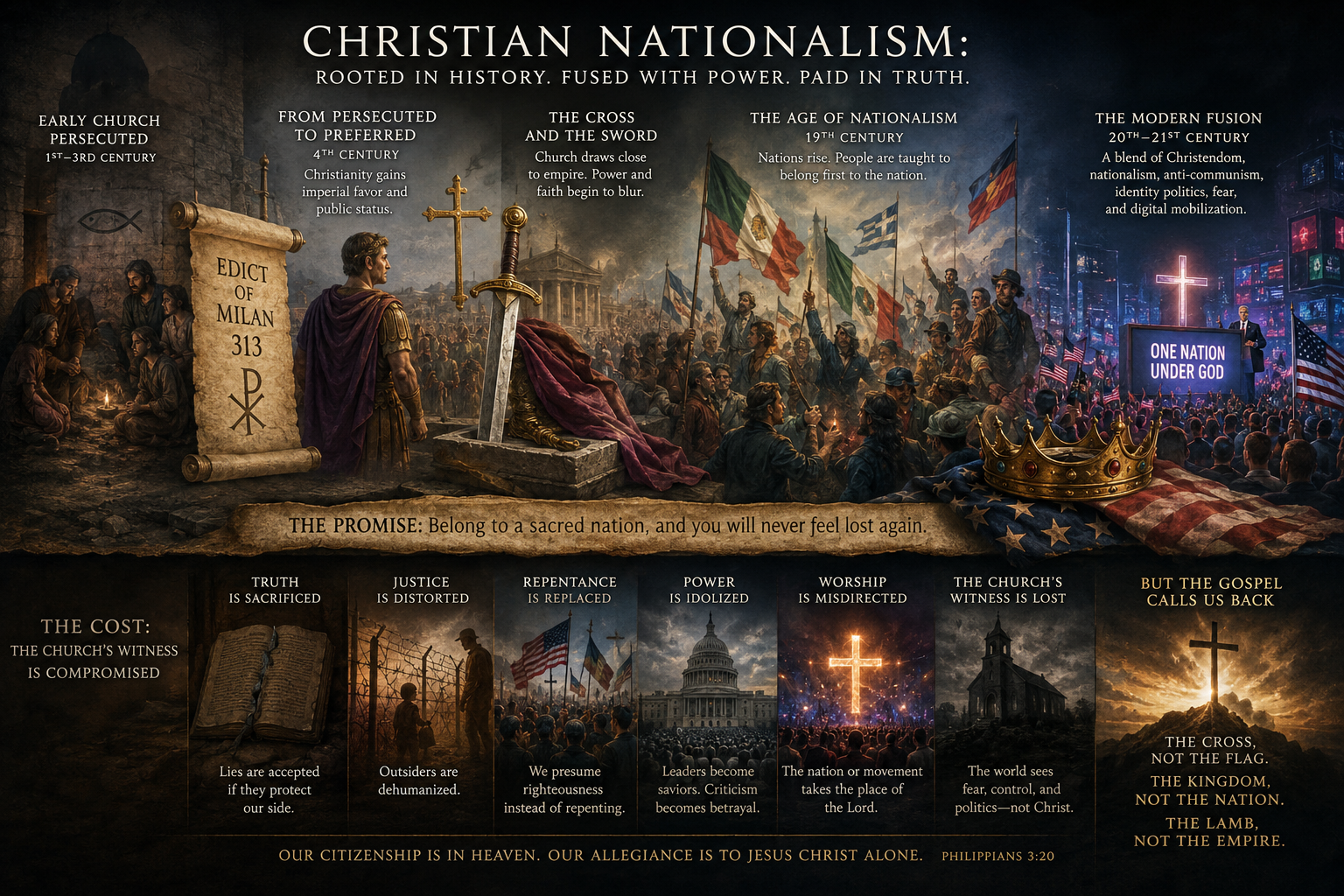
One layer begins in the fourth century, when Christianity moved from persecuted minority faith to favored religion within the Roman imperial world. The Edict of Milan in 313 established religious toleration for Christianity in the Roman Empire, giving the once-persecuted church a new public status.
That moment did not create modern nationalism. But it did open a long debate Christians have never fully escaped: what happens when the church moves close to the empire? What happens when the cross and the sword share a platform? What happens when rulers find Christianity useful, and Christians find rulers flattering?
Another layer came much later with the rise of modern nationalism. The 19th century is considered the “age of nationalism” in Europe, with nationalist movements spreading from Latin America into central, eastern, and southeastern Europe and later into Asia and Africa. Modern nationalism taught people to imagine the nation as a primary identity, often above local, religious, family, or transnational loyalties.
Christian nationalism, as we see it now, is a modern fusion of these older forces. It borrows from Christendom, from modern nationalism, from anti-communist religious politics, from post-Cold War identity struggles, from reaction against secularization, from anxieties over immigration, from fear of cultural change, and from the digital age’s ability to turn fear into mass mobilization.
Its modern growth has accelerated as nations wrestle with economic instability, migration, demographic change, declining trust in institutions, moral confusion, social media radicalization, and the fear that inherited cultural identities are disappearing. In that atmosphere, religious nationalism offers a powerful promise, which is you do not have to feel lost if you can belong to a sacred nation.
But the promise comes at many cost. The most important is the cost to the church’s witness, because Christianity becomes associated with fear, control, resentment, and political power instead of the resurrection, mercy, holiness, and truth.

The United States: Christianity as National Identity
In the United States, Christian nationalism often presents America as a uniquely chosen nation with a divine mission, a covenant-like destiny, and a special relationship with God. It frequently blends Christianity with patriotism, conservative politics, cultural grievance, suspicion of pluralism, and anxiety over national decline.
Pew reported in May 2026 that public familiarity with the term “Christian nationalism” has grown, with 59 percent of U.S. adults saying they have heard or read at least a little about it. Pew also found that 17 percent of U.S. adults now say the federal government should declare Christianity the official religion of the United States, up from 13 percent in 2024.
The American version is often tied to questions about schools, immigration, abortion, sexuality, church-state separation, judicial appointments, public ceremonies, racial superiority and national symbols. But underneath those issues is a deeper struggle over identity. Is America a pluralistic republic in which Christians bear witness faithfully among neighbors of many beliefs, or is America supposed to be an officially Christian nation whose laws, symbols, and institutions privilege Christianity?
For Christians, the theological problem is not that believers care about public morality. The problem is when America begins to occupy emotional and spiritual space that belongs only to the kingdom of God.
The church can love a nation without confusing that nation with Zion. Christians can seek good laws without pretending the state can make people holy. Believers can honor what is good in American history without baptizing every national myth, every political movement, every war, every party, or every leader.
Jeremiah’s warning matters here because Judah’s temple confidence was also a kind of religious nationalism. They believed sacred identity could protect them from judgment. They assumed God’s name attached to their nation meant they were safe. But God would not allow His name to become cover for injustice.
Russia: Holy War, Empire, and Orthodox National Destiny
Russia offers one of the clearest and most dangerous examples of religious nationalism attached to state power.
Under Vladimir Putin, the Russian state and the Russian Orthodox Church have often reinforced each other through language about “traditional values,” Russian civilization, spiritual destiny, and opposition to the secular West. The U.S. State Department’s 2023 religious freedom report on Russia notes that Russian law identifies Christianity, Islam, Judaism, and Buddhism as the country’s four “traditional” religions and recognizes the special role of the Russian Orthodox Church.
Since Russia’s full-scale invasion of Ukraine in 2022, this fusion has become even more explicit. In 2024, the Institute for the Study of War reported that the Russian Orthodox Church had approved a document framing the conflict against Ukraine and the West in explicitly spiritual terms, describing it as a “holy war” and articulating components of Russia’s emerging official nationalist ideology.
This is what happens when Christian language becomes imperial language. War is no longer merely a political act. It is spiritualized. National aggression becomes sacred defense. Military ambition becomes moral duty. Enemies are not just geopolitical opponents, they become enemies of holy civilization.
The fruit is devastating. The church’s witness is compromised. Violence is clothed in spiritual language. The name of God is used to justify destruction.
This pattern should make Christians tremble.
The Bible never allows the people of God to call evil good because it serves the nation.
Isaiah 5:20 warns against calling evil good and good evil. When a state uses religious blessing to sanctify violence, it enters spiritually dangerous territory.
Hungary: Defending “Christian Europe”
Hungary under Viktor Orbán became a model for many nationalist conservatives around the world because it combined anti-immigration politics, anti-LGBTQ policies, attacks on liberal institutions, appeals to “Christian Europe,” and strong centralized political power.
Freedom House’s 2025 report on Hungary says the Fidesz government passed anti-migrant and anti-LGBTQ policies, as well as laws that hamper opposition groups, journalists, universities, and NGOs critical of the ruling party. Orbán has repeatedly framed his political project in civilizational terms; Reuters reported in 2020 that he called for Central European nations to unite around their “Christian roots,” and in 2024 reported that he praised Italy’s Giorgia Meloni as a “Christian sister” with shared cultural roots and common views on strict immigration policies and traditional family values.
That language has political power because it turns policy debates into civilizational warfare. Immigration becomes not only a legal or economic question, but a threat to Christian Europe. LGBTQ rights become not only a moral debate, but an existential danger to the nation’s children. Independent media and NGOs become not watchdogs, but enemies of the people.
The result is a politics of protection that can easily become a politics of control.
The state claims it must defend Christian civilization. Then it expands power over education, speech, civil society, courts, and public life. The nation is told that freedom must be limited so identity can be protected. The people are told that criticism is betrayal. Religion becomes part of the state’s emotional armor.
The biblical question is not whether Christians may defend marriage, family, or religious liberty. The question is whether the methods bear the fruit of the Spirit or the fruit of fear. Galatians 5 does not say the fruit of the Spirit is domination, suspicion, cruelty, and propaganda. It says the fruit of the Spirit is love, joy, peace, patience, kindness, goodness, faithfulness, gentleness, and self-control.
Poland: Catholic Memory, National Suffering, and Political Power
Poland’s recent experience shows another form of Christian nationalism, one deeply connected to Catholic identity, anti-communist memory, national suffering, and cultural conservatism.
Poland is not Hungary. Its history is different, its Catholic heritage is deeper, and its democratic institutions remain more resilient. But under the Law and Justice Party, public life was marked by appeals to national interest and “traditional” Polish Catholic values. Freedom House notes that Poland’s politics have been shaped by a divide between liberal, pro-European parties and those claiming to defend national interests and traditional Polish Catholic values.
The political consequences included conflict over the judiciary, public media, abortion, LGBTQ rights, and Poland’s relationship with the European Union. Freedom House’s 2025 report said PiS exerted considerable influence over Poland’s media sector while in power.
Poland is important because it shows how religious nationalism does not always look like raw theocracy. Sometimes it looks like a culture war over institutions. Courts, schools, media, and family policy become battlegrounds where “faith,” “nation,” and “tradition” are invoked together.
Again, Christians must think carefully. There is nothing wrong with defending the unborn, protecting families, or resisting secular hostility toward faith. But when a political movement claims Christian identity while weakening checks on power, demonizing critics, or making justice depend on party loyalty, the prophetic alarm should sound.
The prophets were not impressed by leaders who used religious language while corrupting justice.

Brazil: Evangelical Power, Populism, and Apocalyptic Politics
Brazil shows how Christian nationalism can grow rapidly through evangelical political mobilization, conservative Catholic alliances, charismatic leadership, culture-war messaging, and anti-leftist fear.
Jair Bolsonaro won Brazil’s 2018 presidential election with overwhelming support from many evangelicals. A 2020 academic study reported that Bolsonaro won with the support of nearly 70 percent of evangelicals and around 50 percent of Catholics, and examined theological frameworks among his religious allies, including apocalyptic dualism and neoconservative Catholicism. Reuters also reported in 2022 that Bolsonaro entered that election cycle with strong support among evangelical Christians, a key demographic in Brazilian politics.
Brazil’s case matters because it shows how spiritual warfare language can become political warfare language. Political opponents become demonic. Elections become cosmic battles. A leader becomes the defender of God’s people. Public policy becomes tied to an apocalyptic story of good versus evil.
This does not mean spiritual warfare is unreal. Scripture teaches that believers wrestle not merely against flesh and blood but against spiritual powers. But the New Testament never authorizes Christians to treat political opponents as subhuman enemies. Ephesians 6 calls believers to truth, righteousness, faith, salvation, the Word of God, and prayer. It does not call the church to propaganda, intimidation, or personality cults.
When spiritual warfare language is detached from the character of Christ, it can become fuel for manipulation.
Italy and Western Europe: Christian Identity Without Christian Practice
In much of Western Europe, Christian nationalism often looks less like revival and more like civilizational branding. Christianity is invoked as heritage, identity, and cultural boundary, even among populations that are increasingly secular or only nominally religious.
In Italy, leaders such as Giorgia Meloni and Matteo Salvini have appealed to national identity, family, Christian roots, and opposition to migration. Reuters reported in 2024 that Orbán praised Meloni as a “Christian sister” who shared cultural roots, and noted their common views on strict immigration policies and traditional family values.
This version of Christian nationalism can be especially deceptive because it does not always require deep discipleship, church life, repentance, or submission to Scripture. Christianity becomes a cultural inheritance to defend rather than a Lord to obey.
The church should be wary when people who show little interest in the Sermon on the Mount suddenly become defenders of “Christian civilization.” The faith once delivered to the saints is not a museum artifact. It is not merely Europe’s old architecture, holidays, cathedrals, and family customs. Christianity is allegiance to Jesus Christ.
When Christianity becomes heritage without repentance, it becomes a shell that politics can easily occupy.
Paul reminded believers in Philippi that their deepest identity was not found in Rome but in heaven. “Our citizenship is in heaven” (Philippians 3:20). Christians may love their nation, serve their community, and participate in public life, but they must never forget that their primary allegiance belongs to another kingdom. Whenever national identity begins to overshadow loyalty to Christ, the church risks confusing temporary citizenship with eternal citizenship. As Christians, our highest loyalty is not to a flag, a party, or a political movement. It is to Jesus Christ, the King whose kingdom will never end.
The Larger Pattern: Religion as a Tool of Power
Across these countries, the details differ. But the underlying pattern is remarkably consistent.
First, leaders identify a threat. The threat may be immigrants, secularists, Muslims, liberals, globalists, LGBTQ people, feminists, journalists, judges, foreign powers, or political opponents.
Second, they frame the nation as spiritually endangered. The country is not merely facing policy challenges. It is under attack from forces that want to destroy its soul.
Third, they present themselves or their movement as defenders of God, faith, family, civilization, tradition, or moral order.
Fourth, they ask for extraordinary loyalty. Criticism becomes betrayal. Compromise becomes weakness. Opposition becomes evil. Legal checks become obstacles to the sacred mission.
Fifth, they use state power to reshape public life. That may include education, courts, media, civil society, immigration policy, religious privileges, restrictions on minority groups, public morality laws, and historical memory.
This is how religious nationalism uses power over people. It doesn't just persuade. It pressures. It rewards loyalty and punishes dissent. It tells people that political obedience is spiritual faithfulness. It turns the nation into an altar and then demands sacrifices.
The Results Are Often the Same
The results of these movements are not identical everywhere, but certain outcomes recur.
Minorities become more vulnerable. Immigrants, religious minorities, ethnic minorities, and sexual minorities are often portrayed as threats to national purity or moral order.
Democratic institutions weaken. Courts, media, universities, election systems, and NGOs are often attacked when they limit the ruling movement’s power.
Religious witness is corrupted. The church becomes associated with coercion, resentment, hypocrisy, and state power rather than mercy, holiness, truth, and Christlike love.
Truth becomes tribal. Facts matter less than loyalty. Lies are tolerated when they serve “our side.” Prophets are rejected because they sound like enemies.
Political leaders become savior figures. People begin to defend a leader’s sin because they believe he protects the nation, the faith, or the church.
The vulnerable are used symbolically. Children, families, the poor, the unborn, workers, soldiers, and persecuted believers may be invoked rhetorically while policies fail to protect their full dignity.
This is why Christians must judge movements not only by their slogans, but by their fruit.
Jesus said, “You will know them by their fruits” (Matthew 7:16). That test applies not only to individuals, but also to movements that claim His name.
Jeremiah’s Warning: The Temple Cannot Cover Sin
Jeremiah 7 is one of the most important biblical texts for this moment.
Judah had the temple, but they did not have obedience. They had religious confidence, but not repentance. They had sacred language, but not justice. They thought the temple guaranteed protection while they oppressed the vulnerable and worshiped other gods.
God was not deceived.
Jeremiah asks whether they will steal, murder, commit adultery, swear falsely, burn incense to Baal, walk after other gods, and then come stand in the Lord’s house and say, “We are delivered” (Jeremiah 7:9–10). The question exposes the lie at the heart of empty religion.
Christian nationalism often repeats that pattern. It says, in effect:
We have the Christian heritage.
We have the Christian symbols.
We have the Christian slogans.
We have the Christian voters.
We have the Christian leaders.
We have the Christian nation.
But God asks different questions.
Do you love mercy?
Do you practice justice?
Do you tell the truth?
Do you protect the vulnerable?
Do you repent of sin?
Do you refuse idols?
Do you love your enemy?
Do you follow Jesus?
The temple did not save Judah from judgment. Religious branding will not save any nation today.
Is This a False Religion?
In one sense, Christian nationalism is not a separate religion with a new holy book, formal priesthood, or official confession.
But spiritually, it can function like a false religion.
It has its own sacred story: the nation was chosen, the nation has fallen, the nation must be restored.
It has its own saints and villains: founders, warriors, leaders, enemies, traitors.
It has its own rituals: rallies, pledges, chants, symbols, patriotic liturgies, public displays of piety.
It has its own doctrine of salvation: if our movement wins, the nation will be saved.
It has its own substitute messiah: the strong leader who promises restoration.
It has its own version of sin: disloyalty to the nation or movement.
It has its own version of righteousness: loyalty to the cause.
That is why the danger is so severe. Christian nationalism does not always reject Jesus openly. Often, it keeps Jesus’ name while replacing His kingdom with a national project.
This is how false religion often works. It does not always begin by denying God. Sometimes it begins by using God.
The golden calf in Exodus was not introduced as atheism. Aaron said, “Tomorrow shall be a feast to Yahweh” (Exodus 32:5). The people used religious language while worshiping a false image. That should sober us. Idolatry can speak in familiar spiritual terms.

The False Gospel Beneath It
At the heart of Christian nationalism is a false gospel.
The true gospel says humanity is lost in sin and can be saved only by grace through faith in Jesus Christ.
The nationalist gospel says the nation is lost because the wrong people gained influence, and it can be saved if the right people regain control.
The true gospel says Jesus conquered through the cross.
The nationalist gospel says victory comes through domination.
The true gospel creates a people from every tribe, tongue, people, and nation.
The nationalist gospel ranks people by blood, soil, language, religion, party, or cultural belonging.
The true gospel calls the church to witness, holiness, mercy, truth, and sacrificial love.
The nationalist gospel calls the church to seize, defend, punish, and preserve power.
The true gospel says Christ is Lord.
The nationalist gospel says Christ is useful.
That difference is everything.
What This Article Is Not Saying
Whenever Christians discuss the relationship between faith and public life, misunderstandings arise quickly. Some readers may hear a warning about Christian nationalism and assume it is a call for Christians to withdraw from society, remain silent about moral issues, or abandon public responsibility altogether.
That is not what this article is saying.
The Bible does not call believers to political indifference. Christians are commanded to love their neighbors, seek justice, defend the vulnerable, care for the poor, pursue truth, and act as salt and light in the world. Throughout Scripture, God’s people speak to kings, challenge injustice, advocate for righteousness, and work for the good of the communities where God has placed them.
Christians should care about the laws that govern society. Christians should care about the protection of children, the dignity of human life, religious liberty, marriage, justice, honesty in government, and the welfare of their communities. Christians may vote, serve in public office, engage in public debate, and work to shape culture according to biblical convictions.
The issue is not whether Christians should participate in public life.
The issue is whether Christians begin to place their hope in political power rather than in Christ.
The issue is whether loyalty to a nation becomes stronger than loyalty to the kingdom of God.
The issue is whether the church begins to excuse sin, corruption, dishonesty, cruelty, or injustice because those things are committed by leaders, parties, or movements it believes will protect its interests.
The issue is whether the name of Jesus becomes a tool for advancing a political project rather than the Lord before whom every political project must bow.
Scripture never asks believers to choose between faithful discipleship and faithful citizenship. It does, however, insist on the proper order of those loyalties.
Paul reminded believers that their citizenship is ultimately in heaven (Philippians 3:20). Jesus declared that His kingdom is not of this world (John 18:36). The early church proclaimed Christ as Lord in a world filled with competing political loyalties. Christians participated in society, but they refused to grant ultimate allegiance to earthly rulers.
The church is at its best when it speaks prophetically to every political tribe rather than functioning as the religious arm of one. The church loses its witness whenever it becomes unable to challenge its own side.
The question, then, is not whether Christians should influence society.
The question is whether society is influencing Christians to place their trust somewhere other than Christ.
The Bible calls believers to public faithfulness. It never calls them to political idolatry.
What Christians Must Recover
Christians do not defeat Christian nationalism by becoming politically indifferent. Withdrawal will not solve the problem. The answer to corrupted public faith is not private faithfulness alone, but faithful public witness shaped by Christ rather than by fear.
We must recover the difference between the kingdom of God and the kingdoms of this world.
We must recover the courage to tell the truth about our own side.
We must recover the prophetic tradition that confronts injustice whether it comes from our enemies or our allies.
We must recover the biblical teaching that every person bears the image of God, including immigrants, prisoners, political opponents, religious minorities, and the poor.
We must recover the Sermon on the Mount, where Jesus blesses the meek, the merciful, the peacemakers, and the persecuted.
We must recover the cross, where the Son of God rejected worldly domination and gave Himself for sinners.
We must recover Revelation’s warning that beastly power often appears glorious, persuasive, and strong before it is finally judged.
Most of all, we must recover worship.
Not worship as performance. Not worship as branding. Not worship as national ceremony. But worship in spirit and truth, where Christ alone is Lord and every earthly loyalty bows before Him.
The Question Before the Church
The global spread of Christian nationalism is not merely a political development. It is a discipleship crisis.
It reveals what people fear. It reveals what churches have failed to teach. It reveals how easily Christian language can be captured by power. It reveals how quickly believers can trade the costly way of Jesus for the emotional comfort of belonging to a righteous tribe.
The church must ask itself a painful question.
Do we want Christ, or do we want Christendom?
Do we want truth, or do we want control?
Do we want repentance, or do we want religious cover?
Do we want the kingdom of God, or do we want a nation that makes us feel powerful again?
Jeremiah stood at the temple gate and told the people not to trust in lying words.
That warning has returned to us.
Do not trust in the flag if the heart is far from God.
Do not trust in slogans if truth is being trampled.
Do not trust in leaders who promise salvation but produce fear, cruelty, and lies.
Do not trust in Christian identity if repentance is absent.
Do not trust in the temple while refusing the Lord of the temple.
The future may bring more of this, not less. As nations grow anxious, leaders will keep reaching for sacred language. As societies fracture, people will continue to long for strong identities. As fear spreads, many will be tempted to trade discernment for certainty and discipleship for power.
But the church is not helpless. We have Scripture. We have the Spirit. We have the testimony of the prophets. We have the warning of Babylon. We have the lordship of Christ. We have the cross.
And the cross tells us what Christian power truly looks like.
It does not manipulate God’s name to preserve itself.
It does not crush the weak to protect the strong.
It does not confuse domination with faithfulness.
It does not worship the beast because the beast promises order.
It follows the Lamb.
The church does not belong to Washington, Moscow, Budapest, Warsaw, Brasília, Rome, or any other capital. The church belongs to Jesus Christ. Nations rise and fall. Empires appear and disappear. Political movements gain influence and lose it. But the kingdom of God endures forever. The church’s hope has never rested in a ruler, a party, a movement, or a nation. It rests in the crucified and risen King whose throne cannot be shaken.
That is the line Christians must draw now, before the slogans grow louder and the deception becomes easier.
Because when Christianity becomes a flag, it can stop looking like the cross. And when the church forgets the difference, it may find itself defending a kingdom Christ never built.
Frequently Asked Questions About Christian Nationalism
What is Christian nationalism?
Christian nationalism is the belief that a nation’s identity, laws, culture, or political future should be formally tied to Christianity in a way that gives Christian identity privileged national status. It is not the same as loving your country, praying for leaders, voting according to biblical convictions, or caring about public morality. The danger begins when national identity becomes fused with Christian identity so tightly that the nation starts to function as sacred. When that happens, political loyalty can begin to compete with loyalty to Christ.
Is Christian nationalism the same as patriotism?
No. Patriotism can be a healthy love for one’s country, gratitude for what is good, and a desire to seek the welfare of one’s community. Christian nationalism goes further by treating the nation as a sacred project and often linking faithfulness to God with loyalty to a particular national or political vision. Christians may love their country, but Scripture teaches that their highest citizenship is in heaven (Philippians 3:20).
Should Christians be involved in politics?
Yes, Christians may participate in public life, vote, serve in office, advocate for justice, defend the vulnerable, and speak truthfully about moral issues. The Bible does not call believers to political indifference. The concern is not public faithfulness. The concern is political idolatry — when Christians place their hope in power, excuse corruption, or use the name of Jesus to advance a political project that does not reflect His character.
Why is Jeremiah 7 important for understanding Christian nationalism?
Jeremiah 7 warns against trusting in sacred symbols while refusing obedience to God. Judah had the temple, religious language, and national identity, but they were using those things to cover injustice and sin. That same warning applies whenever people use Christian symbols, slogans, or identity while ignoring repentance, mercy, truth, and justice.
What is the biblical response to Christian nationalism?
The biblical response is not withdrawal, fear, or silence. It is faithful public witness under the lordship of Christ. Christians must recover the difference between the kingdom of God and the kingdoms of this world. They must speak prophetically to every political tribe, protect the dignity of every person made in God’s image, refuse false saviors, and remember that Jesus Christ alone is Lord.