


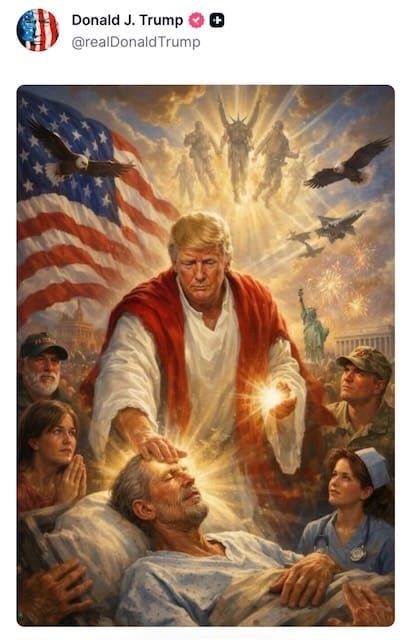
Donald Trump says the AI-generated image he posted of himself in a white robe, with radiant light around him, touching a sick man with a glowing hand, was not meant to portray him as Jesus. He says it was him as a doctor “making people better.” Reuters reported that explanation on April 13 after the image drew backlash even from some religious conservatives who usually support him. Reuters also reported that art historian Brendan McMahon called Trump’s explanation “highly suspicious,” noting that the image borrows from a long tradition of Christian art in which Christ is depicted as healer, with divine light and luminous hands signaling holiness and power.
And that is exactly why this cannot be brushed aside as a joke, a misunderstanding, or a harmless bit of internet vanity. No one is Jesus but Jesus. And mockery in any form should be rebuked and called out as blasphemy. This is a line Christians are not free to blur.
What made the image so offensive was not only that Trump appeared in a pose associated with Christ, but that it came in the middle of his escalating feud with Pope Leo XIV, who has been condemning the war with Iran and calling for peace. Shortly before posting the image, Trump attacked the pope as “WEAK on crime and terrible for Foreign Policy.” Reuters reported that the post of the Jesus-like image came amid that conflict, and after Pope Leo had criticized the war as inhumane and said the Gospel was being “abused.”
That context matters. This was not merely tasteless. It was spiritually disordered. A president under moral rebuke from a church leader posted imagery that many Christians immediately recognized as messianic. Even some of Trump’s own conservative allies called it what it was. Reuters reported that Brilyn Hollyhand called it “gross blasphemy” and wrote, “Faith is not a prop.” Riley Gaines responded, “God shall not be mocked.” They were right to say so.
Christians should be clear about why.
The first reason is theological. Jesus Christ is not a symbol of generic healing, generic greatness, or generic leadership. He is the Son of God, the image of the invisible God, the crucified and risen Lord. “There is salvation in no one else,” Acts 4:12 says, “for there is no other name under heaven given among men by which we must be saved.” Scripture does not leave room for messianic cosplay around political power. Isaiah 42:8 says, “I am the Lord; that is my name; my glory I give to no other.” The glory that belongs to Christ is not available for political branding, digital fantasy, or ego maintenance.
The second reason is moral. Scripture repeatedly warns against self-exaltation. “Whoever exalts himself will be humbled,” Jesus says in Matthew 23:12. In Acts 12, Herod receives the praise of people who say, “The voice of a god, and not of a man,” and because he does not give glory to God, judgment falls on him. The lesson is not subtle. Leaders are never safer than when they are humble, and they are never more dangerous than when they begin to accept images of themselves that belong only to heaven.
The third reason is ecclesial. Church leaders are not permitted to stay silent when public sin is public and spiritually corrupting. Ephesians 5:11 says, “Take no part in the unfruitful works of darkness, but instead expose them.” Titus 1:13 speaks of sharp rebuke when truth is being compromised. And while 1 Timothy 5:20 addresses elders specifically, the principle is relevant here too: open sin requires open correction for the sake of the community. When a national leader turns Christian imagery into a tool of self-display, pastors, bishops, priests, and ministry leaders should not mumble. They should speak.
That is especially true because Trump’s defenders will inevitably try to reduce all of this to overreaction. They will say people are too sensitive. They will say it was trolling. They will say he never literally claimed to be Christ. But blasphemy does not have to arrive as a formal doctrinal statement to be real. Sometimes it arrives through aesthetic suggestion, symbolic theft, and the casual use of holy things for self-glorification.
And that is what this image did.
A doctor image would have looked like a doctor image. This was something else entirely: a white robe, a glowing orb, a suffering figure beneath Trump’s hand, radiant light around his body, and a visual style that, in the words of an art historian, gestures toward the Christian tradition of Christ as healer. Trump later denied the point of the image, but a denial after publication does not erase what was published. It was received as a Jesus-like portrait because it was constructed to be read that way.
That is also why Christians should be careful not to minimize what symbolism does. Images preach. They disciple. They form instinct and desire. A glowing hand is not neutral. A white robe is not neutral. A figure bent over the sick in radiant light is not neutral. These things carry meaning, especially in a culture saturated with Christian memory. And when people in the MAGA movement pray to Trump as if he were God. To many viewers, the robe did not suggest medicine. It suggested purity. The red sash did not suggest hospital attire. It suggested sacrificial imagery. The glowing hands did not suggest competence. They suggested supernatural power. The upward gaze of the surrounding admirers did not read like consultation. It read like reverence. Whatever Trump says he intended, the visual sermon told a different story.
And it was a wicked story.
Because at bottom, this is not only about one image. It is about a political culture that keeps inching toward idolatry while asking the church to call it strength. The Christian faith does not permit that confusion. The church does not exist to anoint rulers with divine aura. It exists to preach Christ crucified, to call sinners to repentance, and to remind every earthly authority that it is dust before God.
That is one reason Pope Leo’s rebuke matters so much here. Reuters reported that Leo said he would keep speaking against war because “too many innocent people are being killed” and because “someone has to stand up and say there’s a better way.” He said the “message of the Gospel” was being abused. That line should haunt every Christian leader in America. If the Gospel is being abused, then ministers of the Gospel cannot be neutral about the abuse.
This is where the American church has often failed. It has tolerated in politicians what it would rebuke in ordinary members. Pride becomes “boldness.” Cruelty becomes “strength.” vanity becomes “confidence.” Mockery becomes “telling it like it is.” And now apparently even messianic imagery can be excused as trolling, provided the right people are owning the right enemies. But Scripture does not grade blasphemy on a partisan curve. God is not impressed by electoral strategy. He is not moved by crowd size, media reach, or political leverage. “God shall not be mocked,” Galatians 6:7 says. That verse still applies when the mockery is digital, stylized, and posted by a president.
Some will say this is too harsh. It is not. It is not harsh to defend the uniqueness of Christ. It is not harsh to say that presidents are men, not saviors. It is not harsh to insist that Christian symbols are not stage props for political ego. It is not harsh to remind the church that flattery toward rulers has always been one of its oldest temptations and one of its ugliest sins.
In fact, the harshness would be in the silence.
If pastors and priests cannot clearly say that no one is Jesus but Jesus, then they have already begun surrendering ground they were never permitted to give away. If bishops can speak boldly about private sins but grow timid when public power wraps itself in sacred imagery, then they are not shepherding faithfully. If Christian leaders only rebuke blasphemy when it comes from cultural outsiders, but not when it comes from politically useful men on their own side, then their moral witness is already compromised.
Trump later said the image showed him as a doctor. But Christians are not obligated to pretend they do not know what they are looking at. No words needed to be spoken, the image described it clearly. It drew from the visual grammar of Christ. And when the visual grammar of Christ is used to magnify a political leader, the church has a duty to answer with clarity.
So let the answer be plain.
No one is Jesus but Jesus.
Not a president.
Not a pope.
Not a party.
Not a nation.
Not a movement.
Not a man with glowing hands in an AI portrait.
Jesus Christ alone is Lord. And every leader who forgets that truth, or plays games with it, deserves rebuke, not reverence.