


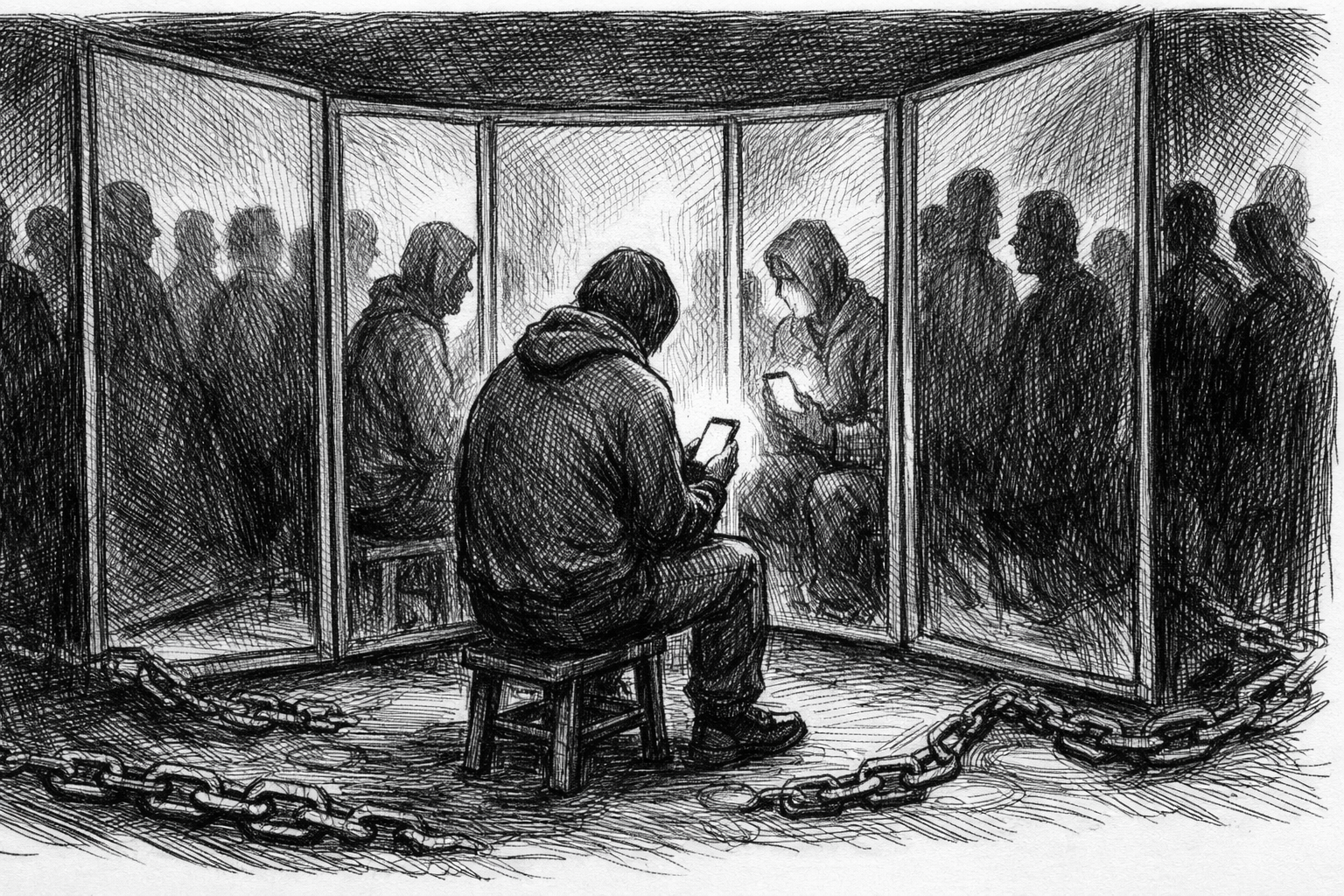
It rarely begins with a crisis. More often, it begins with a habit.
A person wakes up and reaches for the small glass rectangle on the nightstand the way earlier generations reached for a prayer book. The gesture is not dramatic. It is almost liturgical. Thumb scrolls. Eyes flick. The mind starts taking attendance. Who liked what. Who said what. What happened overnight. What the world is angry about. What the world is celebrating. What the world thinks is unforgivable now. And somewhere beneath the informational current, a quieter question rises like an undertow.
Where do I fit in all this.
Who am I supposed to be today.
What version of myself will survive the room.
Cultural selfhood is not the private self. It is the self as a public project, the self as a performance shaped by the invisible crowd. It is identity with a constant audience, a soul living under fluorescent lights. You do not simply exist. You must be legible. You must be coherent. You must be current. You must have a stance.
In older tyrannies, the ruler sat on a visible throne. In this one, the throne is distributed. It belongs to everyone and no one. Cultural selfhood is enforced by an economy of approval and a fear of misstep. Its laws are not written in stone but in trends, and its punishments come not through jail but through exclusion, ridicule, or the slow freezing-out that makes a person question their own reality.
The genius of the system is that it feels like freedom while it works like control.
It tells you to be authentic, but it also trains you to perform your authenticity. It tells you to find your voice, but it also tells you which voices count. It tells you to embrace your truth, but it also tells you that truth must always arrive with a hashtag and a tribe. And if you want to remain safe, you learn to anticipate the crowd’s weather the way farmers once anticipated storms. You begin to manage your life as if it were a public relations campaign for your own existence.
There is a kind of weariness that comes from living this way. You can feel it in your shoulders, in the way you rehearse conversations before you have them, in the way you craft sentences in your head that are less about honesty than about survival. You become fluent in implication. You learn what not to say. You learn how to nod without consenting. You learn how to condemn the right things quickly so no one suspects you might be complicated.
In the end, cultural selfhood does not make you deep. It makes you vigilant.
It also makes you lonely. Because belonging built on performance is not belonging. It is probation.
Scripture, which has never been sentimental about the human condition, has a word for this. Not for the phone, exactly, or the crowd, exactly, but for the spiritual geometry underneath it. “The fear of man lays a snare,” Proverbs says (Prov. 29:25). A snare is not a brick wall. It is a hidden loop. You do not see it until it tightens. It is the trap of living with other people as your ultimate authority.
Most people do not think of this as worship, but it functions like worship. You orient your life around what you fear and what you crave. You sacrifice honesty for acceptance. You offer your attention as tribute. You bring your anxiety to the people’s altar every morning and call it normal.
The Bible’s critique is not that people should not care what others think. Love requires attention. Wisdom requires consideration. Community requires mutuality. The critique is that the crowd cannot bear the weight of being God. It cannot give you a stable name. It cannot give you peace. It cannot save you.
The New Testament is blunt about what happens when the self becomes a cultural artifact, shaped primarily by the eyes of others. “Do not be conformed to this world,” Paul writes, “but be transformed by the renewing of your mind” (Rom. 12:2). The word translated “conformed” carries the sense of being pressed into a mold. Cultural selfhood is precisely that. It is the mold. It offers you pre-made shapes of personhood. Pick one. Wear it. Speak its language. Signal your place. And if you drift outside the outline, the world has a thousand ways to remind you you’re exposed.
To “snap out of it,” in biblical terms, is not to reject society or become socially careless. It is to step out of the mold and return to reality. It is to remember that you are not made by the crowd. You are made by God. You are not owned by the moment. You are claimed by Christ.
The metaphor that best captures the experience is not a prison cell, though it can feel like one. It is more like a room full of mirrors. Everywhere you turn, you see yourself reflected, judged, compared, and measured. Even when you try to focus on someone else, you catch yourself watching your own face. How you’re coming across. How you’re being received. How you’re being interpreted. The tyranny is that you can’t stop looking.
The gospel does something radical. It breaks the mirror.
It does not do this by telling you to hate yourself, or to “just stop caring,” which is advice that tends to work only for the already secure. It breaks the mirror by giving you a different gaze to live under. Not the gaze of the crowd, but the gaze of God.
Jesus speaks to this with unnerving simplicity. “You are of more value than many sparrows,” he says (Matt. 10:31). It’s a sentence that could be mistaken for sentiment until you notice what he’s doing. He is relocating value. He is pulling worth out of public opinion and placing it in the Father’s care. He is giving you a name that cannot be revoked by a trending outrage.
Paul does this even more directly when he says, “If I were still trying to please man, I would not be a servant of Christ” (Gal. 1:10). That line is not a license to become harsh. It is a diagnosis. Two masters cannot both be ultimate. Either the crowd names you, or Christ does. Either the moment defines you, or the gospel does.
And then comes the phrase that operates like a doorway out of the room of mirrors. “In Christ.”
It is easy to treat those two words as religious wallpaper, but in the letters of Paul they function like a new address. The believer’s life is relocated. The self is no longer suspended in the unstable weather of cultural approval. It is anchored “in the Beloved” (Eph. 1:6), named by grace, adopted into a family, redeemed with blood, sealed with the Spirit. These are not decorative ideas. They are structural. They are what makes it possible to live with clarity without living with fear.
Cultural selfhood trains you to ask, What do they think of me. The gospel trains you to ask, What has God said about me. The first question makes you a chameleon. The second makes you a person.
Snapping out of cultural selfhood is not a single act of willpower. It is more like regaining circulation in a limb that has fallen asleep. At first you feel the pins and needles. It’s uncomfortable to stop performing. It’s disorienting to speak honestly. It can feel risky to be calm when the crowd is frantic. But over time, something returns. Agency. Joy. Peace. The ability to be present.
There are a few ways this snapping-out becomes practical, and none of them are glamorous.
One is to recover the difference between conscience and crowd. Conscience is the inner awareness before God. The crowd is the outer pressure before people. The crowd is loud and reactive. Conscience is quiet and steady. The crowd tells you to win. Conscience tells you to be faithful. The crowd rewards speed. Conscience requires truth.
The renewing of the mind Paul speaks about in Romans is not merely learning new facts. It is learning a new reflex. It is learning to pause before reacting. It is learning to ask not only what is popular, but what is true. Not only what is safe, but what is righteous. Not only what will be applauded, but what will last.
Another way is to practice what Jesus calls secrecy. In the Sermon on the Mount, Jesus repeatedly tells his followers to do righteous things “in secret” rather than “to be seen by others” (Matt. 6:1–6). He is not promoting private virtue as a brand. He is weakening the addiction to being watched. Cultural selfhood feeds on visibility. Secret faithfulness starves it.
There is also the quiet discipline of resisting instant identity. The culture wants you to declare yourself quickly. To take a side quickly. To signal where you belong. The gospel does not demand that speed. The gospel often asks for patience, humility, and the courage to be misunderstood. “Let every person be quick to hear, slow to speak, slow to anger,” James writes (Jas. 1:19). That is not just interpersonal wisdom. It is cultural resistance.
And then there is the most subversive act of all. Worship.
Worship is not merely singing. It is the re-centering of the soul on something higher than the self and stronger than the culture. It is the act of saying, with your time and attention and love, You are God and I am not. In a culture that turns everything into self-expression, worship is an act of rebellion. It refuses to make the self the sun.
This is why Jesus’ invitation is not, “Come to me and I will give you a better brand.” It is “Come to me… and I will give you rest” (Matt. 11:28). Rest is not found in being perfectly understood by people. Rest is found in being held by God.
The quiet tyranny of cultural selfhood does not end because you finally craft the perfect version of yourself. It ends because you stop living under the wrong gaze. It ends when you no longer treat culture like a judge and start treating God as Father. It ends when “in Christ” becomes more than a phrase and becomes a place you actually inhabit.
The world will continue to churn. It will continue to change the rules. It will continue to demand immediate clarity and instant allegiance. But the Christian, who is striving to live within the “In Christ” has a steadier center. A different clock. A different audience. A different name and a standout brand.
And that is how you snap out of it. Not with a dramatic exit, but with a quiet refusal. You stop offering your soul as tribute to the moment. You step out of the mold. You let God name you again.
The strangest thing is what happens next. You become more human, not less. More present. Less frantic. Less performative. More able to love, because you are no longer using people as mirrors. More able to speak honestly, because you are no longer negotiating your existence. You begin to live as if you are not a cultural artifact, but a creature. God’s clarity and wisdom begin to build within you and soon you’ll find rest.
The tyranny is quiet. So is the freedom.