

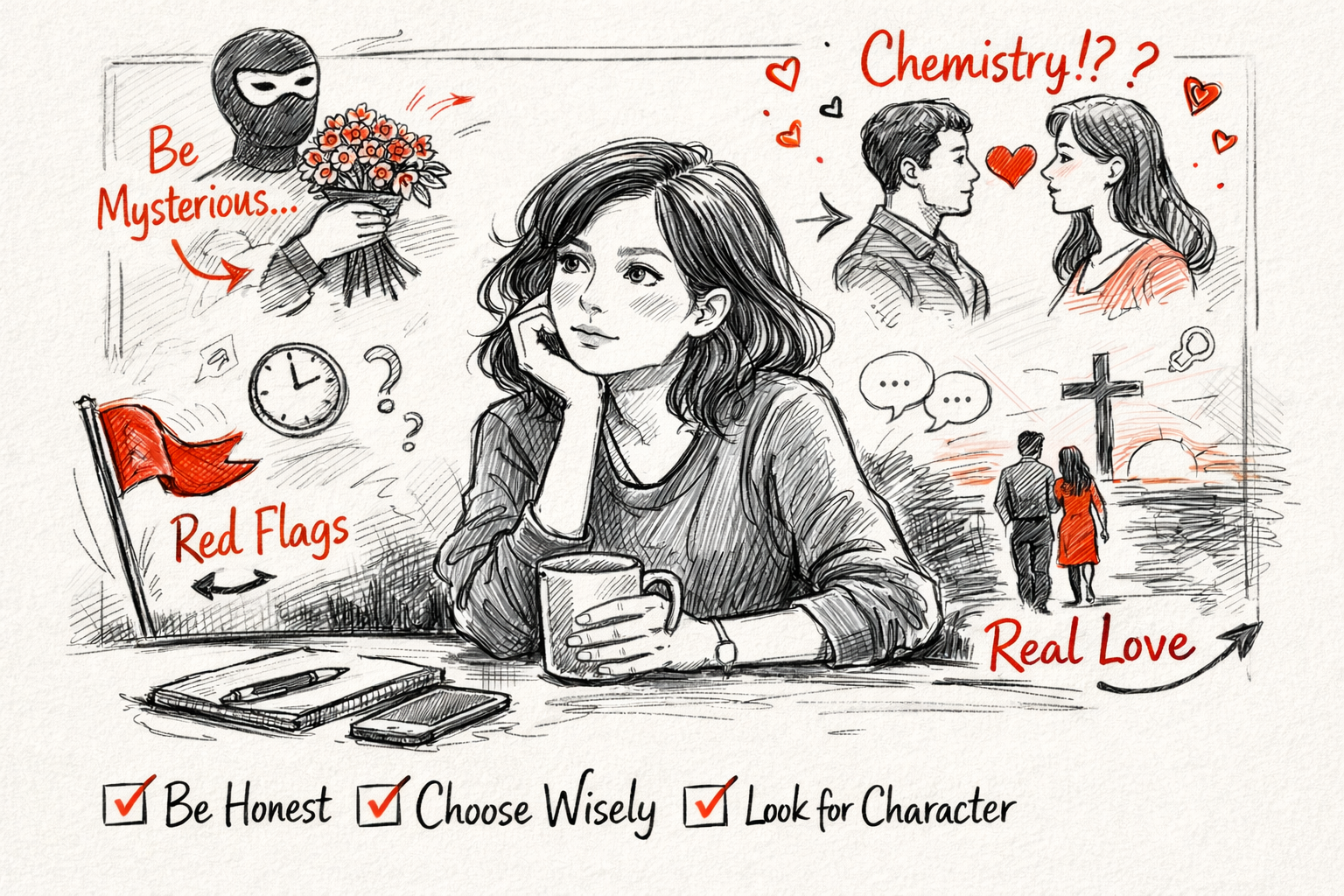
As a woman in her 30s and dating, I've found that when I ask people for dating advice, everyone has something different to offer. I've heard everything from "be more mysterious". "Text less and make him wait for you instead". To, "Wait two hours before replying and don’t seem too eager. And keep your options open." Everyone has their own piece of advice based on their experiences, but I find that rarely, and I don't want to seem ungrateful, but most of the advice doesn't fit my situation.
And the weirdest thing about it is taking the advice and actually doing what they've told me is just as exhausting as trying to find someone to date. And for many people in the dating pool who are asking for advice, it is not only exhausting but deeply unhelpful.
What I've found is that most dating advice misses the point. I feel like I'm being trained on how to avoid the bad eggs but not how to recognize character that goes with the bad egg. Some bad eggs are easy to weed out, don't get me wrong. But others are more difficult. Anyone can tell you how to get a date, but not how to choose wisely. And I've noticed during this process that I have become more anxious, more guarded, and more disconnected from what I actually want.
Dating is hard guys.
So let me offer some simple advice. What works is not trying to pretend to be someone your not. What works is clarity, consistency, honesty, and being yourself. Your true authentic character.
If we want to find a relationship that is healthy, stable, and worth building, we have to stop centering our attention on chemistry alone. Chemistry is real and important but it is not rare, and it is not enough. You can feel drawn to someone who is completely wrong for you. You can feel excitement around a person who does not know how to love, communicate, commit, or tell the truth. Attraction may open the door, but it cannot carry the stress and burdens of a real relationship for the long haul.
So for me, what matters more than immediate spark is whether a person is emotionally safe. Do they communicate clearly so I know their boundaries, stressors, needs and wants? Do they respect my boundaries? Are they kind when things are inconvenient? Do their words and actions match? Do I believe them when they tell me something? Can they handle disappointment without punishing me for it? These questions aren't glamorous but they are far more useful.
And let's just be honest, a lot of people get hurt because they keep trying to interpret mixed signals. Today's society calls emotional unavailability independence. And we call rejection failure in a relationship which makes us put the issue on ourselves as a heavy burden to fix. But one of the most important dating lessons to learn is this: clarity is kindness. It's ok to discuss your core values and believes with the person your interested with and more importantly dating. It's ok to discuss waiting for marriage to be intimate. And it's ok to be yourself. And the same goes for the other person. Someone who is genuinely interested in you should not leave you constantly guessing about who they are. Are they being honest? What are their long-term plans? They may have the same reservations. They may move slowly. They may be cautious. They may not know everything they feel right away. But over time, their interest should become clearer and so should yours.
If someone is genuinely interested in you, values you, and wants to pursue you seriously, you should not have to construct the entire relationship out of hope and possibility. I've learned to pay attention to patterns and not promises. People reveal themselves through repetition. The person who keeps canceling, disappearing, avoiding hard conversations, lying or offering just enough attention to keep you attached is already teaching you what life with them will feel like.
And that brings me to another point that dating advice often avoids: stop overlooking what is obvious because you are afraid to start over. I've done this and trust me, you would rather start over with the right person than waste time with someone who doesn't share your values and beliefs.
Sometimes the relationship does not feel confusing because love is hard to understand. Sometimes it feels confusing because the person keeps changing. Sometimes you are not “asking for too much.” Sometimes you are asking the wrong person. There is a difference.
What works in dating is not pretending to need less than you do. It is learning to tell the truth about what matters to you. If you want commitment, say that. If you want marriage, say that. If you want emotional maturity, spiritual seriousness, or a shared vision for family life, do not bury those desires just to seem easygoing. The right person will not be frightened by healthy honesty. The wrong person may be, but that is useful information.
It is also important to stop treating loneliness like a reason to lower your standards. Loneliness can make almost any attention feel meaningful. It can also make red flags look small and bare minimum effort feel precious. But desperation clouds discernment. If you are hungry enough, you will call crumbs a feast. That is why wise dating requires you to be anchored in something deeper than your fear of being alone.
The healthiest people to date are usually not the ones trying hardest to win everyone over. They are the ones who know who they are, who have learned how to be honest, and who are not asking a romantic relationship to rescue them from themselves. You do not need perfection. But you do need substance. Look for people who are accountable, humble, teachable, and able to repair themselves after conflict because you can't fix them. Look for people who have a real life, real integrity, and real capacity for commitment.
And please do not ignore how someone treats other people. Watch how they speak about former partners. Watch how they treat waitstaff, family members, strangers, and anyone who has nothing to offer them. Charm directed at you alone is not the same thing as character. Sooner or later, that person will treat you the way they treat people they are no longer trying to impress.
A relationship is not simply about mutual attraction. It is about whether two people can walk in the same direction with integrity. Shared faith is not just a line on a profile. It is a way of seeing life, commitment, sacrifice, forgiveness, money, sex, family, suffering, and purpose. It is one thing for someone to say they believe in God. It is another thing for their life to show reverence, humility, and conviction. You are not just looking for someone who can quote the right things. You are looking for fruit.
And the final lesson I have learned is to stop trying to be chosen. My job is to become honest enough, healed enough, and grounded enough to recognize what is good when it appears. Dating becomes far less chaotic when you stop asking, “How do I make this person want me?” and start asking, “Is this actually good for me?”
That is what most dating advice misses. It focuses on being wanted instead of choosing wisely. But the goal is not just to be admired. It is to build something real.
What actually works is not performance without honesty, charm without steadiness, or attraction without integrity.
What works is clarity. What works is discernment. What works is truth.
And what works, in the long run, is choosing someone whose presence brings peace, not confusion.