

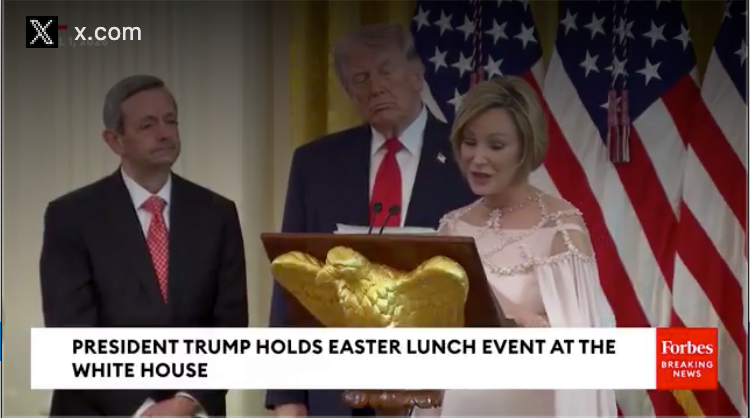
There are moments when a sentence does more than misspeak. It reveals something badly disordered in the Trump spiritual advisors. Paula White-Cain’s remarks at the White House Easter lunch on April 1, 2026 were one of those moments. During the event, White-Cain said she felt led by the Holy Spirit to tell President Donald Trump how thankful she was for him, and she praised him as “the greatest champion of faith” she had ever seen in a president. The remarks drew immediate backlash from Christian leaders, with some calling them “blasphemous” and “heresy.”
This is not a minor controversy over tone. It is a warning about what happens when Christian language is used to elevate political power beyond its rightful place. Paula White-Cain is a longtime Trump ally and was appointed on February 7, 2025 to serve as senior adviser to the White House Faith Office, the office President Trump established that same day by executive order.
That proximity to power is precisely what makes this moment so serious. The closer faith leaders stand to political authority, the greater the temptation to confuse gratitude with devotion, access with anointing, and policy wins with spiritual righteousness. Christians may absolutely pray for presidents. We are commanded to pray for our leaders. Scripture tells us to pray for kings and all in authority so that we may live peaceful and godly lives. The Church has always prayed for rulers, even flawed ones.
But prayer for leaders is not worship of leaders. Honor is not exaltation. Gratitude is not glory. All glory belongs to God!
Heresy. And Jeffress, and other “pastors”, standing there clapping. Ripping scripture out of context. Abusing the text. I wish some of these spiritual leaders would actually lead spiritually. https://t.co/8SZmRm79pc
— Benjamin Watson (@BenjaminSWatson) April 2, 2026
There is a line Christians must never cross.
That line is crossed the moment language that belongs uniquely to Jesus Christ is draped over a politician. It is crossed when a president is praised in ways that echo the suffering, humiliation, vindication, or redemptive significance of Christ. It is crossed when a leader’s rise is described in tones so spiritually inflated that the distinction between servant and Savior begins to blur.
This is why so many believers reacted so strongly. The problem was not merely that Paula White-Cain complimented the president. It was that the praise reached into holy territory. Christians do not believe Jesus is one great champion among many. We believe He is the sinless Son of God, the Lamb who was slain, the One who bore our sins in His body on the tree, the One who rose again on the third day in victory over sin, death, and hell. His betrayal was not political inconvenience. His arrest was not persecution theater. His suffering was not a metaphor for public criticism. His death was an atoning sacrifice. His resurrection was the decisive victory of God for the salvation of the world.
That is why comparisons of this kind are not just awkward. They are offensive.
They offend the uniqueness of Christ’s ministry. They diminish the meaning of His sinless life. They trivialize the cross. They cheapen the resurrection. And in Holy Week, of all times, they do so in the shadow of the very mystery Christians gather to adore.
Only Jesus saves.
That sentence should not be controversial in the Church, yet moments like this reveal how easily people can speak as though salvation arrives by influence, cultural dominance, court appointments, executive orders, or political access. It does not. Acts 4:12 leaves no room for confusion: “There is no other name under heaven given to mankind by which we must be saved.” Psalm 146 warns us not to put our trust in princes. Philippians 2 tells us that the name above every name belongs to Jesus, not Caesar, not a party, not a president, not even a well-liked defender of causes Christians care about.
A president can sign laws. A president can appoint judges. A president can open or close doors. A president can help create favorable or worse conditions for believers to live and worship freely. Those things matter. They are not meaningless. But a president cannot forgive sin. He cannot reconcile sinners to God. He cannot conquer death. He cannot redeem the conscience. He cannot raise the dead heart to life. He cannot stand in the place of Christ.
That place is already occupied.
And that is what makes all forms of political idolatry so dangerous. Because it does not always begin with outright denial of Jesus. Often it begin with overstatement and flattery and language that sounds patriotic and spiritual. But the most disappointing of all is that the words were spoken in a room full of religious people, who stood and applauded the very words that marginalize what Jesus' sacrifice on the cross was for the faith. Jesus’ sacrifice was not just a human sacrifice, as though He were a man dying a tragic death. It was a divine sacrifice, holy and set apart, because Jesus was not only fully man but fully God. On the cross, He did not simply suffer at the hands of men; He willingly offered Himself as the spotless and sinless Lamb of God to take away the sins of the world. His death carried eternal weight because it was the sacrifice of the Son of God—perfect, powerful, and sufficient to accomplish what no ordinary human sacrifice ever could. Through His death and resurrection, Jesus secured redemption, defeated sin and death, and made a way for humanity to be reconciled to God. To compare this to any individual is wrong and is blasphemy.
This is a very sobering moment in the faith community.
This is not only about Paula White-Cain. And it is not only about Donald Trump.
The deeper issue is that large parts of American Christianity have become willing to measure faithfulness by political usefulness. If a political leader gives church leaders access, we call him courageous and transparent. If he fights our cultural enemies, we call him bold. If he says a few sympathetic words about God, we begin to treat him as though he were providentially untouchable. And without even realizing it, criticism starts to feel like betrayal, discernment starts to feel like disloyalty, and biblical clarity starts to feel inconvenient.
But the Church was never called to make politicians feel messianic. The Church was called to bear witness to the Messiah.
For many watching from home, a simple phrase like “May God bless America” is enough to stir a kind of misplaced devotion, causing them to elevate a political leader into the role of a savior he was never meant to occupy. And for those with direct access to power, the temptation is often even greater made by the choice to protect that access rather than offer biblical correction. But the Bible does not teach us to judge by religious language or public displays of reverence alone. Jesus warned that not everyone who says, “Lord, Lord,” truly knows Him. In many ways, the standing ovation in that room revealed just how easy it has become to confuse spiritual language with genuine faith.
Christians must recover the moral clarity and courage to resist giving any public official the reverence, praise, or significance that belongs to Christ alone. That restraint is not weakness, it is the mark of true Christian political sobriety.
The Church does not serve presidents best by flattering them. It serves them best by refusing to lie about them and too them.
When Christian leaders fail to do this, the church looses its witness by sounding impressed with worldly power. Christian leaders need to remember that Christianity was born under empire, survived without cultural dominance, and spread across the world not through access to the palace but through fidelity to a crucified and risen King.
This is where the offense becomes personal for every believer.
If we heard those remarks and felt no discomfort, something is wrong. When language that comes dangerously close to exalting a politician in ways reserved for Christ no longer unsettles the Church, it reveals how compromised our spiritual discernment has become. The issue is not simply that the praise was overblown. It is that many believers have become so accustomed to exaggeration, so long as it benefits their preferred leader, that they no longer recognize when devotion has crossed a sacred line.
But Jesus will not share His glory.
“I am the Lord; that is my name! I will not yield my glory to another or my praise to idols.” - Isaiah 42:8:(NIV)
Jesus will not be reduced to a symbol for our political ambitions. He will not be enlisted as an accessory to state power. He will not be honored with our lips while His uniqueness is diluted by our applause. He remains what He has always been: the Holy One, the crucified One, the risen One, the Judge of the nations, and the only Savior of the world.
That is why I believe Paula White-Cain’s remarks were out of line in the deepest possible way. They were not merely politically awkward. They trespassed on sacred ground. They pushed praise of a man into language that dishonors the One Man through whom alone we have redemption. They were, in that sense, an offense to the ministry, sinless life, Jesus' horrific death and sacrifice, and resurrection of Jesus Christ.
Christians should say so plainly.
This is not about refusing to honor leaders or pray for them. We should. But we must never forget where the line is. Easter belongs to Jesus. The cross belongs to Jesus. The risen victory of the empty tomb belongs to Jesus. Our salvation belongs to Jesus. And what belongs to Christ alone must never be handed over to any man, any movement, or any nation.
If the American church wants to recover its witness, it must learn again how to stand near power without bowing to it. It must learn how to thank leaders without sanctifying them. It must learn how to speak with conviction without slipping into adoration. Above all, it must remember that the Gospel does not announce the triumph of a political figure. It announces the triumph of Christ.
And that changes everything.