

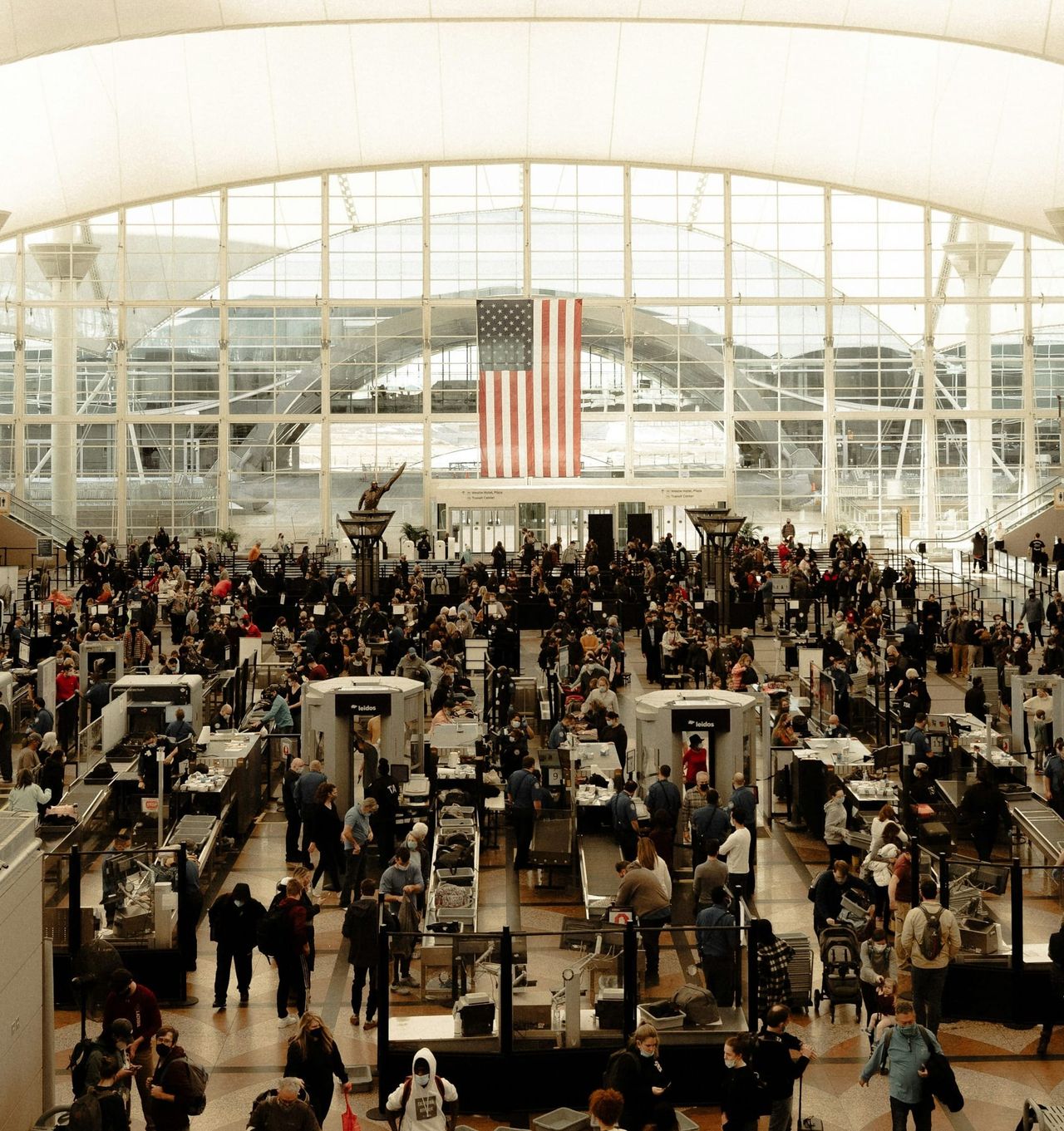
Spring break has begun, and with it the annual pressure at the airport. But this year the strain feels sharper, the lines longer, the mood thinner. In some airports, travelers have reportedly waited more than five hours just to reach a TSA officer at security. In ordinary years, spring-break travel is a familiar American inconvenience: the seasonal migration of children in hoodies, parents clutching boarding passes, and college students dressed for climates more optimistic than the one outside. This year, it has begun to feel less like a nuisance than a stress test.
At the center of the strain is the Transportation Security Administration, whose officers have been working through a Department of Homeland Security funding impasse that began on February 14. The standoff has left tens of thousands of TSA workers without pay, even as airports move into one of the busiest travel stretches of the year. Reuters and the Associated Press report that nearly five hundred TSA officers have quit during the impasse, that absentee rates have climbed above ten per cent, and that spring-break passenger volumes are running about five per cent above last year’s. At some airports, travelers have encountered waits of four hours or more.
Houston’s George Bush Intercontinental has become one emblem of the moment, though it is hardly alone. Long lines have also been reported in Atlanta and New Orleans, and federal officials have warned that, if staffing pressures worsen, smaller airports could face closure so that personnel can be shifted to larger hubs. In a gesture both practical and revealing, Homeland Security has deployed hundreds of immigration officers and investigators to assist at fourteen airports with duties such as checking identification and crowd control. The arrangement is meant to keep lines moving.
People will tolerate a great deal if they believe the system is functional. What is harder to stomach is the suspicion that the strain is no longer incidental but structural and that the line is not long because everybody decided to go to Orlando on the same morning, but because the institution charged with moving people through the line is itself fraying. The airport then stops feeling like a portal and starts feeling like a referendum.
There is, of course, a political drama wrapped around all of this. President Trump said this week that he would order the government to pay TSA agents, and the Senate approved a partial funding measure aimed at addressing at least part of the crisis. But even where temporary fixes emerge, the episode has already made something plain. A nation that can route millions of passengers through a web of terminals, scanners, and gates still depends, in the end, on workers showing up for a paycheck and on lawmakers remembering that “essential” is not just a category for press releases.
Spring break has always had a faintly comic quality. It is a season of collective overestimation, when Americans convince themselves that the trip will be restorative, the children will remain cheerful, and the airport will behave like a well-designed hallway rather than a test of character. But the comedy turns brittle when the line becomes a map of public neglect. The traveler removes a belt, then shoes, then a laptop, then some final residue of dignity. Around him, everybody performs the little rituals of compliance. The line inches ahead. A toddler cries. Someone misses a flight. Nobody, exactly, is surprised.
What makes the present crunch memorable is not just the inconvenience. It is the way inconvenience has become interpretive. A staffing shortage becomes a travel delay, a travel delay becomes a family story, and the family story becomes a political judgment uttered into a phone while standing beside a trash can at Gate C17. This is how institutions lose their abstraction. They stop being nouns and become lived experiences: a closed checkpoint, a four-hour wait, a frustrating phone call to the hotel saying we’re going to be late.
One suspects that, long after the funding votes are tallied and the staffing charts repaired, many travelers will remember this spring not for the beach or the reunion or the brief encounter with sun, but for the line. People will remember the long fluorescent corridor, the uneasy patience, the vague sense that the country had asked ordinary people to absorb yet another failure as though it were unforeseen and uncontrollable. And perhaps that is the real stress test—not whether the planes take off, but how much strain a public will accept before it starts to wonder what, exactly, is being held together, and by whom.