


When I was a kid and got into trouble, I dreaded that long walk home. I grew up in the 70’s and 80’s and yes I am telling my age. Back then when we got into trouble there were consequences that were not just grounding, they were physical. I recall how my feet felt heavy because I knew what waited for me. I knew I had done wrong, and consequences were had to be paid. Somehow, that walk always seemed like the longest and loneliest journey because I of the anticipation of the punishment that was to come. I remember my fear and trembling—not quite sure what to expect, how long it would last but certain the outcome would not be good.
Back then, we didn’t just get spankings or get grounded—we got whipped, and believe me, it hurt. I remember one particular time when my sister and brother got in trouble for fighting. I was so terrified of being caught up in their punishment that I ran away from the house altogether. That fear of consequences was very real to me. In life we have consequences for our actions, whether they be good or bad. It’s literally the result of everything we do.
Yet as I listened today to a song called The Day the Earth Stood Still by Brian McKnight, my thoughts were drawn to something far greater than the punishments I feared as a child. I was reminded that Jesus took upon Himself the consequences I truly deserved. Every sin I have committed, and every sin I ever would commit, was laid on Him at the cross. The judgment that should have fallen on me, Christ carried in my place. What I once understood only in small, earthly terms as punishment and consequence pointed me to a much deeper truth: Jesus bore the full weight of my sin so that I could receive mercy instead of condemnation.
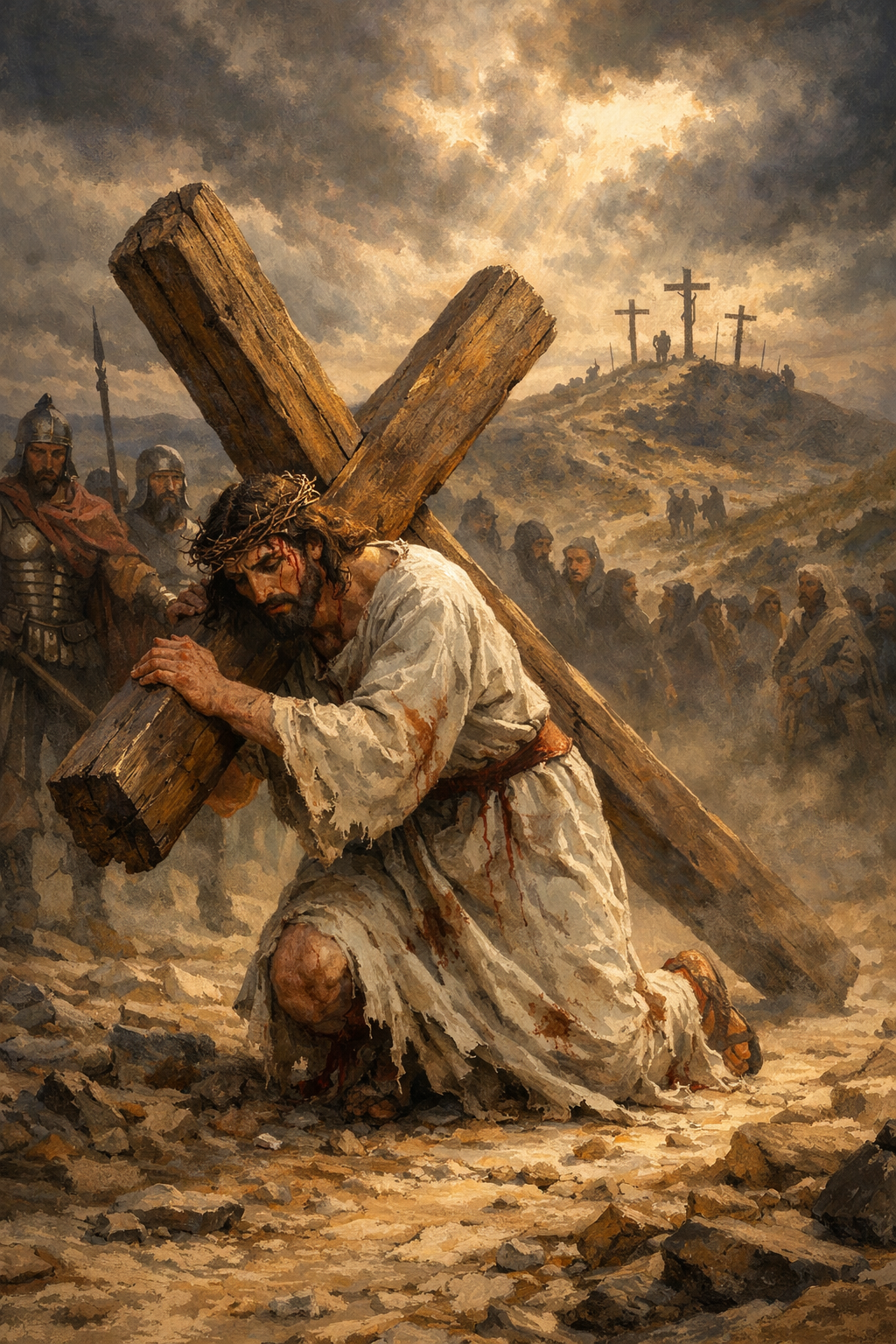
As I reflected on how Jesus walked that long and lonely road to Calvary, and I tried to imagine the weight of His experience. Surrounded by crowds of people, some who even witnessed His miracles and kindness, cheered on His suffering as He carried both the cross and the crushing burden of our sin. From an eternal perspective, He knew the price He would pay to redeem us, yet He never wavered or chose another way. Long before His birth, He knew about the beatings, the tearing of His flesh, the agony of the nails, and the grief of being abandoned by those He loved who said they would never leave Him. Yet the deepest pain of all was not physical—it was the agony of separation from His Heavenly Father as He bore the full weight of our sin.
As I read about His journey to the cross, I could not shake the weight of how much suffering was borne over so short a distance. Though the distance from His trial before Pilate to Calvary was less than half a mile—about 600 yards—the suffering along that path made it the longest and heaviest walk in human history. Surrounded by crowds who cheered on His pain and mocked His weakness, He staggered beneath the wooden crossbeam, His back shredded open from the scourging. Blood streamed down His face from the crown of thorns, His body trembling from the relentless beatings. The streets pressed in with onlookers—some weeping, others sneering—while soldiers pushed Him forward without mercy. From an eternal perspective, Jesus knew the price He would pay to redeem us, yet He never wavered or turned aside.
The Gospels record that He was mocked and struck repeatedly. Roman soldiers hit Jesus with their hands (John 19:3), spit on Him, and beat Him with a reed (Mark 15:19). These were multiple blows, not just one. He was scourged—flogged by Pilate’s order (John 19:1). Roman scourging was notorious for its brutality. The whip, called a flagrum, was embedded with sharp pieces of bone, lead, or metal that ripped into flesh. Each lash tore deeper, often exposing muscles, veins, and even bones. Victims sometimes died before even reaching the cross.
Under Jewish law, a criminal could receive no more than forty lashes (Deuteronomy 25:3). To be safe, the Jews usually stopped at thirty-nine (Paul mentions receiving this in 2 Corinthians 11:24). But Jesus was scourged by Romans, and under Roman rule there was no set limit. The number of lashes was left entirely to the cruelty of the soldiers, and they were often merciless. Jesus was beaten multiple times—by the Jewish leaders (Matthew 26:67–68), by the guards, and finally by the Romans after Pilate handed Him over (Mark 15:15–20). Roman scourging was not quick. It was intentionally drawn out, with pauses to prolong the suffering, leaving the victim too weak to stand.
It was enough to leave Him so broken that He could not carry His own cross the full distance, and Simon of Cyrene was forced to help Him (Luke 23:26). Isaiah 52:14 foretold this moment centuries earlier: “His appearance was so marred, beyond human semblance, and His form beyond that of the children of mankind.” His beating was so severe that He was nearly unrecognizable.
And while we don’t know the exact number of lashes or the precise length of time, Scripture and history together paint a vivid picture: Jesus endured a merciless beating, one designed to utterly break Him physically, emotionally, and spiritually. Yet He endured it all for our sake.
“But He was pierced for our transgressions; He was crushed for our iniquities; upon Him was the chastisement that brought us peace, and with His wounds we are healed.”
— Isaiah 53:5
The stripes He bore across His back were not meaningless blows of human cruelty—they became the pathway of our healing. Each lash was absorbed for our forgiveness. Every drop of blood shed was poured out to cleanse our sin. The crushing weight of the cross, the nails driven into His hands, and the separation from His Father were all endured so that we would never have to bear the punishment of our guilt.
What looked like the end of hope on that brutal day was in fact the beginning of redemption. His wounds brought us wholeness. His rejection brought us acceptance. His death brought us life.
As He bore the full weight of humanity’s sin, Jesus cried out, “My God, My God, why have You forsaken Me?” (Matthew 27:46). For the first time, He experienced distance from the Father, because sin separates us from a holy God (Isaiah 59:2). Even though Jesus Himself was without sin (2 Corinthians 5:21; Hebrews 4:15), He willingly carried ours.
And here is the powerful truth: what I once feared as a child—punishment as my consequence—no longer has the same grip on me. Why? Because the debt has already been paid in full. The Bible says, “There is therefore now no condemnation for those who are in Christ Jesus” (Romans 8:1). That long walk of dread has been replaced with the freedom of grace.
When I ran away as a child to avoid consequences, it didn’t remove my guilt. But when Jesus bore my punishment on the cross, it removed my guilt forever. His sacrifice means I don’t have to run anymore. Instead, I can come boldly before the throne to God, not as a fearful child waiting for punishment, but as a beloved son or daughter welcomed into His arms (Hebrews 4:16).
The message is this, sin does separate us from God, but Christ’s sacrifice bridges that separation once and for all. What was once a long and lonely road for us to walk, Jesus walked in our place. And now, because of His love, the walk home is not filled with fear—it is filled with hope.