


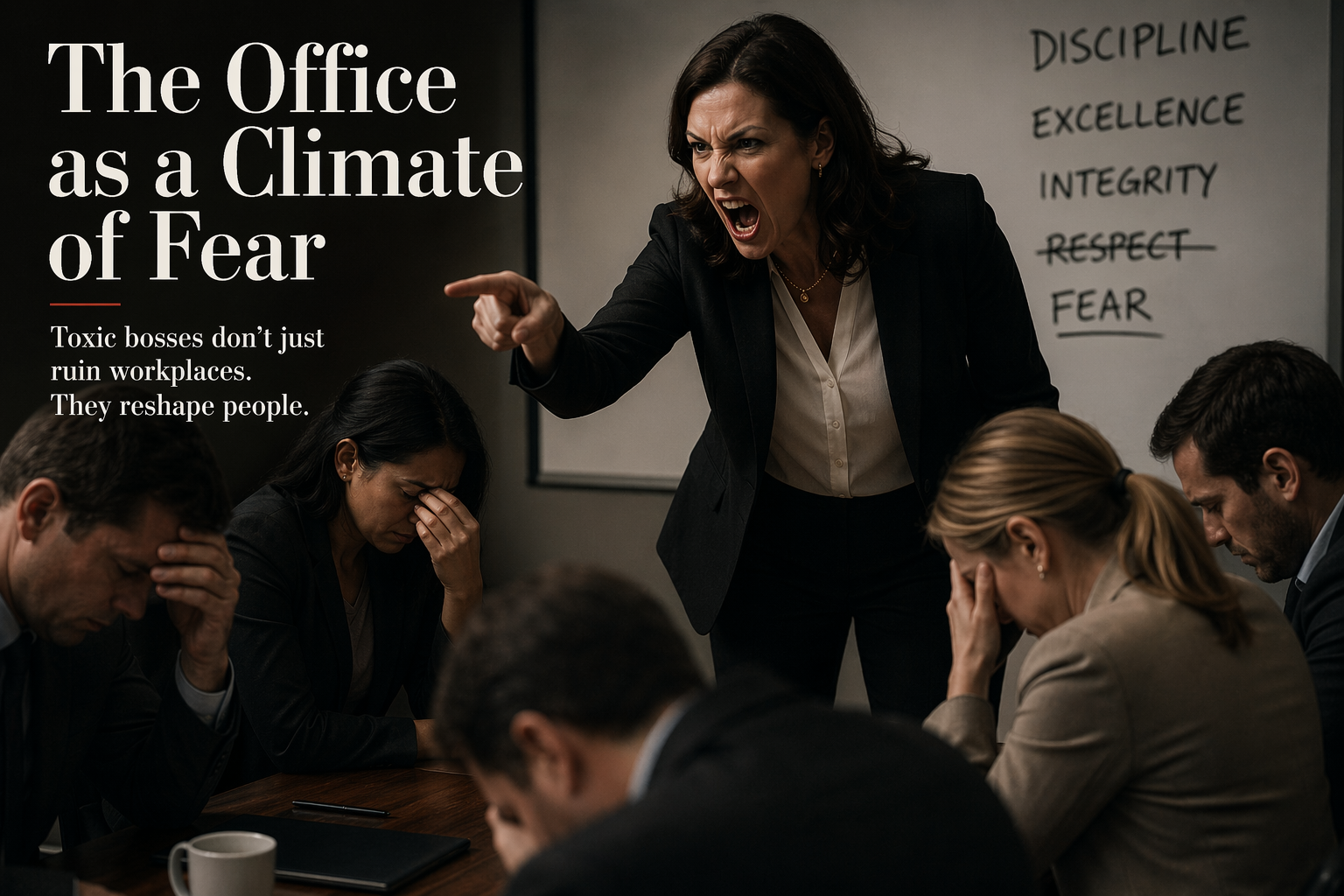
I worked for someone a few years ago whom I can now describe, without overstating it, as a tyrant. At first, that word would have seemed far too severe. She was polished, articulate, and carefully composed. She spoke with the kind of grace that often persuades people to mistake elegance for character. She knew Scripture, used it fluently, and carried herself in a way that suggested not only competence but spiritual maturity. When things were running smoothly, she could even seem warm, reasonable, and easy to work with. But that is often how these stories begin—with a surface so controlled and convincing that almost no one recognizes, at the outset, what is waiting underneath.
The real version of her emerged whenever something went wrong—or even when she merely decided that it had. Those were not always the same thing. A minor mistake could set off an outburst so explosive and degrading that a room of more than thirty people would fall completely silent. Bodies tensed. Eyes dropped. Everyone braced themselves for the torrent of insults and profanity that might follow. What looked, from the outside, like an ordinary meeting could in seconds turn into a public humiliation. She had a relentless way of pressing and provoking until someone cried, walked out, or shut down entirely in that defeated way people do when they realize they are no longer in a safe environment.
I had never worked for anyone who seemed so polished and professional on the surface yet proved so combative and destructive in practice. Her temper was so volatile that there were moments when I did not just fear another round of yelling—I feared she might physically lash out. That never happened. But fear does not need physical contact to do its damage. It only needs unpredictability and power.
I left that job in less than two years, and I was far from the only one. After I left, more than half the company eventually followed. By that point, leaving no longer felt like an ordinary career decision. It felt like getting out. Employees filed EEOC complaints, and lawsuits were brought against both her and the company; some were won, others were settled. But regardless of the outcomes, the experience stayed with me. It affected me so deeply that I eventually went to therapy to deal with the trauma it left behind.
What still unsettles me is how completely hidden it was at the start. Before I accepted the position, I spoke with more than twenty people. Not one of them warned me. Not one hinted that beneath the professionalism was a culture of intimidation. That, too, belongs to the story of toxic leadership. Horrible bosses never introduce themselves as horrible bosses.
This is part of what makes workplace cruelty so difficult to explain to people who have never experienced it. People imagine the problem as occasional rudeness, a difficult temperament, a manager who communicates badly. But the modern toxic boss is often more than rude. They are atmospheric. They alter the way people think, speak, plan, answer emails, conduct themselves in meetings, and carry their bodies on the drive home. Their behavior becomes the familiar and it breeds a company culture that soon follows.
That is one reason workplace bullying persists. It is not because organizations fail to recognize it. It is because fear, in the short term, can look useful. It produces compliance. It accelerates responses. It suppresses dissent. It keeps people off balance. And in far too many workplaces, that is close enough to efficiency for leadership to look the other way.
The research suggests this is not some marginal problem. SHRM reported in 2024 that 66 percent of workers had experienced or witnessed incivility in the prior month, and 57 percent had experienced or witnessed it in the previous week. The Workplace Bullying Institute found that 32.3 percent of adult Americans reported having been directly bullied at work, and that in 55 percent of those cases the primary perpetrator was a boss.
Those numbers are sobering, but they still do not fully capture what it feels like to work inside a workplace ruled by fear. The damage is not limited to the person most directly targeted. It radiates outward. A culture of intimidation teaches people to censor themselves before they are ever asked to. It teaches them to over-explain harmless decisions, to over think, to read danger into tone, to anticipate blame, and to deliver bad news and brace for the incoming threats, profanity and insults. It teaches them that honesty is risky and that survival depends less on doing good work than on learning how to read emotional behavior.
That is why the phrase toxic boss can sometimes feel too mild. Toxicity suggests contamination, which is true, but it can also sound passive, almost chemical. What many people experience is more active than that. It is domination dressed up as leadership. It is control enforced through volatility. It is power displayed through the steady diminishing of other people.
And yet organizations remain strangely fluent in euphemism. They call such a leader intense, demanding, direct, high standards-driven, not for everyone. They say she gets results. They say he is old-school. What they often mean is this person is feared, and we have decided, at least for now, that fear is an acceptable management strategy. This was the strategy the board took with my toxic CEO. And this is also where the board failed not only me but the rest of the company.
But this is where I need to make a clear distinction. A demanding boss is not automatically a bully. High standards are not abuse. Difficult decisions are not cruelty. But there is a line, and a great many workplaces have learned how to cross it elegantly. The line is crossed when correction becomes degradation, when accountability becomes intimidation, when a leader’s authority depends on making other people feel and look smaller.
The Equal Employment Opportunity Commission makes clear that unlawful harassment generally requires conduct based on a protected characteristic such as race, religion, sex, age, or disability, and that it must be severe or pervasive enough to create a hostile work environment. The EEOC also notes that petty slights, annoyances, and isolated incidents usually do not become illegal unless they are especially serious. So to put this plainly, there is a vast territory of workplace cruelty that may be unethical, destabilizing, and spiritually corrosive without fitting neatly into the legal category of discrimination.
That gap matters more than many people realize. A boss can terrorize a team through humiliation, threats, intimidation, and emotional volatility while remaining just inside the outer boundary of legal exposure. Employees know this. They understand the arithmetic. HR may listen politely. Leadership may promise review. But if the bully brings in revenue, protects someone important, or knows how to perform remorse upward while continuing cruelty downward, an institution can persuade itself of almost anything.
That is one reason so many people stay longer than outsiders think they should. Fear is not only emotional. It is economic. Rent is due. Insurance matters. Children need braces. Finding another job takes time. So people endure more than they should, telling themselves the boss may improve, that perhaps they have misread the situation, that what feels like a pattern may only be a bad season. By the time they stop hoping, something in them is often already frayed.
The harm is measurable. A 2025 systematic review and meta-analysis in BMC Public Health found that workplace bullying was associated with a stronger intention to leave and summarized broader research linking bullying with depression, anxiety, stress, sleep problems, emotional exhaustion, and reduced well-being. Another meta-analysis on witnessing bullying found that even bystanders experienced worse health and well-being outcomes. Fear does not remain confined to the person being targeted. It becomes environmental.
This is one of the least acknowledged features of workplace bullying: it is profoundly formative. It trains people. It teaches them what truth costs. It teaches them whether institutions mean what they say about values, integrity, and human dignity. It teaches them whether the people in charge are serious about character or concerned about optics.
Gallup has argued for years that managers account for most of the variance in team engagement, and its 2026 State of the Global Workplace report found that global manager engagement had fallen to 22 percent in 2025, while overall employee engagement dropped to 20 percent. That finding is useful in part because it reveals how often organizations create the conditions for bad leadership and then act surprised by the kind of leaders those conditions produce. Managers are frequently promoted for output, not maturity; rewarded for urgency, not steadiness; handed authority without ever being formed in how to carry it.
Still, lack of training is not the whole story. Some bosses are overwhelmed. Some are unsupported. Some are poorly formed but still capable of correction. And then there are those who genuinely enjoy the asymmetry of power. They like what fear does to a room. They like being the person everyone else must watch carefully. They like the small liturgies of intimidation: the late-night message, the public rebuke, the withheld approval, the strategic silence, the praise that can curdle into contempt in an instant. In those cases, workplace bullying persists because there are people to whom domination feels natural, and institutions willing to call that instinct leadership so long as the bottom-line remains healthy.
From a Christian perspective, the issue is not difficult to name. It is sin—more specifically, the misuse and corruption of authority. Scripture is unsentimental about power. Jesus warns against those who lord it over others. Peter instructs leaders not to be domineering. Paul tells masters to stop threatening those under their authority. The biblical vision of leadership is not weakness, but stewardship. Authority is given so that others may flourish under it, not diminish beneath it. A leader who rules by fear may still be impressive. That does not make them good.
That is one reason I have grown suspicious of the polished vocabulary many workplaces use when they talk about culture. Culture is often treated as mood, branding, engagement language, or internal storytelling. But culture is moral before it is aesthetic. It is the repeated answer to a simple question: what kind of conduct is normal here? If people are regularly shamed, frightened, destabilized, or emotionally managed, then the culture is not merely demanding. It is disordered.
And when that disorder is led by someone who quotes Bible verses, the corruption deepens. Spiritual language in the mouth of an unrepentantly cruel person does not soften the cruelty. It intensifies the confusion. It makes workers doubt their own instincts. It wraps fear in legitimacy. It tempts onlookers to excuse conduct because the offender sounds morally literate. One of the more unsettling truths about abusive leadership is that religious vocabulary can become just another form of camouflage.
I often think now about how many people saw what I saw only after it was too late. How many knew and said nothing. How many left quietly. How many convinced themselves they were overreacting before finally admitting they were living under something destructive. Toxic bosses do not only damage résumés. They damage a person’s trust in work itself. After I left, I started my own company, partly because something in me could no longer imagine placing that degree of power over my life in someone else’s hands again.
That is not a universal lesson, and I would not romanticize it. Not everyone can leave. Not everyone should start over. But I understand now why so many do. There comes a point when the question is no longer whether a job is sustainable in professional terms. The question becomes whether the job is costing more of you inwardly than it should ever demand.
Workplace bullying persists because too many institutions still believe fear is affordable. It is not. The bill merely arrives later—in attrition, illness, silence, diminished truth-telling, and whole teams of people who learn how to survive without ever really belonging.
And perhaps that is the clearest indictment of all. A workplace should not have to become illegal before it becomes intolerable. A boss should not have to strike someone before everyone admits violence is already in the room. And leadership should never be praised for producing results if the method depends on making human beings smaller than God intended them to be.