

Lord, teach me how to study Your Word with humility, patience, and understanding. Help me not to feel overwhelmed, but to come to Scripture with a willing heart. Open my eyes to see what You are saying, strengthen my faith, and help me apply Your truth to my daily life. In Jesus’ name, amen.
Studying the Bible can feel intimidating when you are just beginning. You may open Scripture with a sincere desire to know God, but quickly feel unsure of what to do next. Should you read a whole chapter? Focus on one verse? Look up the original language? Take notes? Follow a plan? Use a commentary? Memorize something? Pray first? Journal afterward?
For many beginners, the hardest part of Bible study is not a lack of desire. It is a lack of direction.
You want to understand God’s Word, but you may not know how to move from reading a passage to actually studying it. You may wonder how to find the meaning, how to apply it correctly, or how to avoid misunderstanding the text. You may even feel guilty because Bible study seems easier for other people than it does for you.
But Bible study is not meant to be a burden. It is an invitation.
God has given His Word so His people may know Him, trust Him, obey Him, and grow in wisdom. Second Timothy 3:16–17 teaches that all Scripture is breathed out by God and useful for teaching, correction, and training in righteousness. That means the Bible is not simply a book to admire. It is God’s living Word, given to form us into faithful followers of Christ.
The good news is that you do not need to begin with a complicated system. You can start with simple, faithful methods that help you slow down, observe the text, understand the meaning, and respond in obedience.
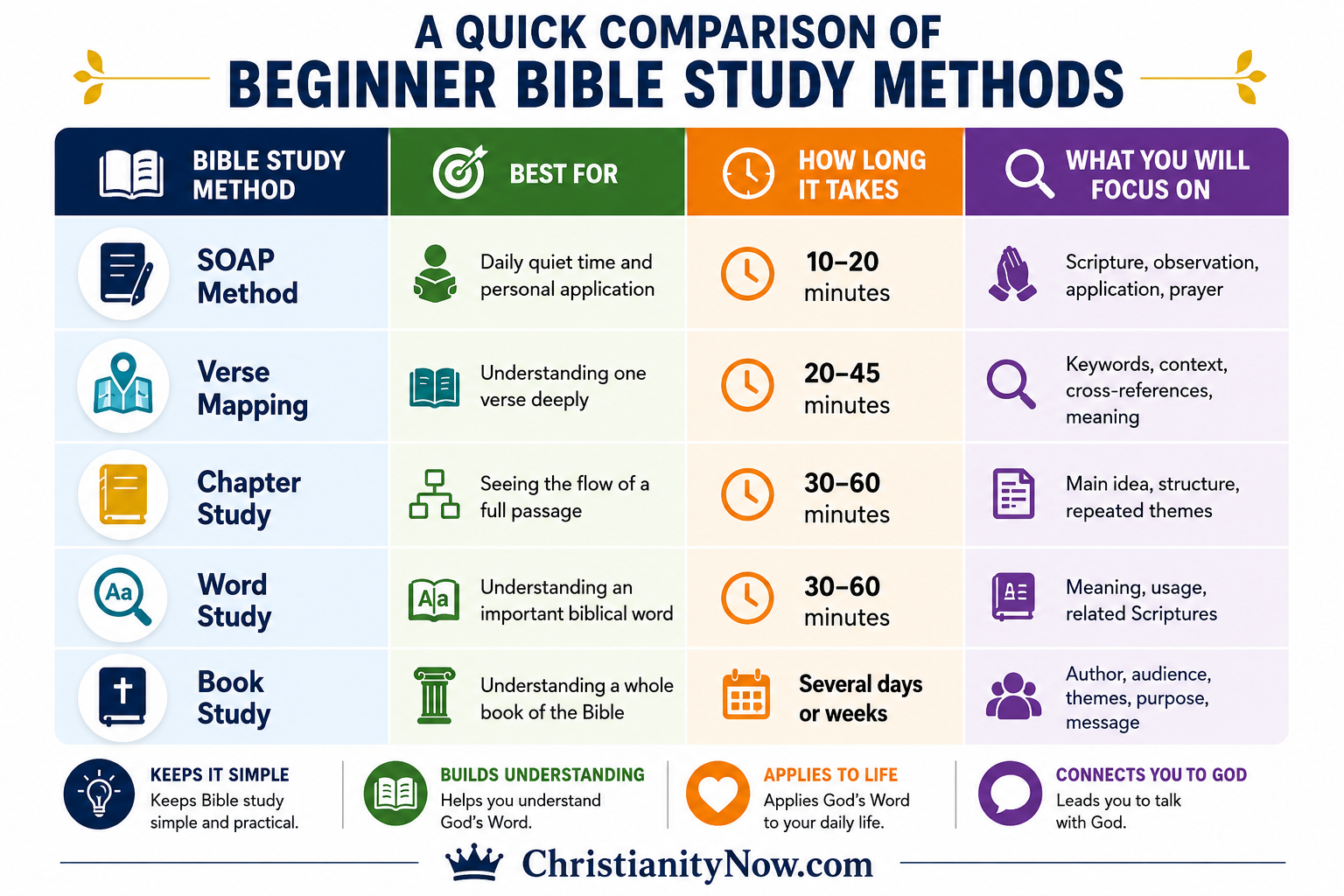
Here are five Bible study methods for beginners: SOAP, verse mapping, chapter study, word study, and book study.

A Quick Comparison of Beginner Bible Study Methods
Each method serves a different purpose. You do not have to use all of them at once. Think of them as tools. Some days you may need a simple SOAP study. Other days you may want to slow down and map a verse. As you grow, you may begin studying entire chapters or books.
The goal is not to master every method immediately. The goal is to become more faithful and attentive as you study God’s Word.
Method 1: The SOAP Method
The SOAP method is one of the simplest Bible study methods for beginners. SOAP stands for Scripture, Observation, Application, and Prayer.
This method works well for daily Bible reading because it is structured but not overwhelming. It helps you move from reading a verse to thinking about what it says, how it applies, and how to respond to God in prayer.
Start by choosing a short passage. This could be a few verses, a paragraph, or one chapter. Then write down one verse that stands out to you. That is the Scripture part.
Next, observe what the verse or passage says. Ask basic questions: Who is speaking? What is happening? What words are repeated? What does this reveal about God? What does this reveal about human nature, sin, faith, obedience, suffering, or hope?
Then move to application. Ask, “How should this truth shape my life today?” Application should be personal and specific. Instead of writing, “I need to trust God,” you might write, “I need to trust God with the situation I keep trying to control.”
Finally, respond in prayer. Thank God for what He has shown you. Confess sin if the passage convicted you. Ask for help to obey. Pray the truth of the passage back to Him.
For example, if you study Philippians 4:6–7, you may write down the command not to be anxious, observe that prayer and thanksgiving are connected to peace, apply it by bringing a specific worry to God, and pray for His peace to guard your heart and mind in Christ.
The SOAP method is helpful because it keeps Bible study simple and practical. It teaches beginners to read, notice, apply, and pray.
Method 2: Verse Mapping
Verse mapping is a deeper way to study one verse carefully. It is especially helpful when a verse feels meaningful, confusing, powerful, or worth memorizing.
Many people quote Bible verses without understanding their context. Verse mapping helps prevent that. It slows you down and teaches you to look at the verse more carefully.
To begin, choose one verse. Write it out by hand. Then circle or underline key words. Look for words that carry meaning, such as grace, faith, righteousness, covenant, peace, mercy, abide, redeem, holy, or wisdom.
Next, look at the surrounding context. Read the verses before and after it. Ask what the author is talking about. Is this part of a prayer, command, warning, promise, letter, poem, prophecy, or story?
Then compare the verse with one or two other translations. This can help you notice wording differences and clarify meaning. You do not need to become an expert in biblical languages to benefit from this step. Simply noticing how faithful translations phrase the verse can help you understand it better.
After that, find cross-references. Cross-references are other Bible passages that connect to the same theme or word. For example, if you are mapping John 15:5, where Jesus says He is the vine and His followers are the branches, you might also look at passages about abiding, fruitfulness, and dependence on God.
Finally, summarize the verse in your own words and write one application.
Verse mapping is best when you want to slow down and study one verse deeply instead of rushing past it. It helps you see that even a single verse can carry rich meaning when studied carefully.
Method 3: Chapter Study
A chapter study helps you understand a larger section of Scripture. While verse mapping focuses on one verse, chapter study helps you see the flow of thought across a whole chapter.
This method is helpful because Bible verses were not originally written to be isolated as inspirational quotes. They belong within larger arguments, stories, songs, prophecies, and teachings. Studying a chapter helps you understand the main idea and how each part connects.

To do a chapter study, begin by reading the entire chapter once without taking many notes. Try to get the overall feel. Then read it again more slowly.
Write down the main events, commands, themes, or teachings. Notice repeated words. Pay attention to contrasts, such as light and darkness, wisdom and foolishness, flesh and Spirit, fear and faith, pride and humility.
Then ask, “What is the main message of this chapter?” Try to summarize it in one or two sentences.
For example, Romans 8 contains many important truths: life in the Spirit, freedom from condemnation, adoption as children of God, suffering and future glory, the Spirit’s help in weakness, God’s sovereign purpose, and the assurance that nothing can separate believers from the love of God in Christ. A chapter study helps you see how these truths connect rather than treating each verse as a separate thought.
Chapter study is especially useful in the Gospels, Acts, the Epistles, Genesis, Exodus, Psalms, Proverbs, and many other books where themes develop across a passage.
This method teaches you to read Scripture in context and helps you understand the movement of a biblical passage.
Method 4: Word Study
A word study focuses on one important biblical word. This method is helpful when a word appears often or seems central to understanding a passage.
Words matter in Scripture. Biblical words like faith, grace, repent, justify, sanctify, covenant, kingdom, holiness, righteousness, mercy, and glory carry deep meaning. But sometimes modern readers assume they know what a word means without studying how the Bible uses it.
To do a basic word study, choose one word from a passage. Start by writing the verse where you found it. Then look up the word in a Bible dictionary or concordance. You can also search for other verses where the same word appears.
Ask:
- How is this word used in this passage?
- Where else does this word appear in Scripture?
- Does the meaning develop across the Bible?
- What does this word teach me about God, salvation, obedience, or Christian living?
For example, if you study the word “grace,” you might begin with Ephesians 2:8–9, then look at John 1:14–17, Romans 3:24, Titus 2:11–14, and 2 Corinthians 12:9. You would begin to see that grace is not only God’s kindness toward sinners, but also His power that saves, teaches, sustains, and transforms.
A word study can become very detailed, but beginners should keep it simple. The goal is not to show off technical knowledge. The goal is to understand God’s Word more clearly.
Word studies are helpful when you keep them connected to the passage. Do not study a word in isolation and ignore the context. The meaning of a word is shaped by how it is used in a sentence, passage, book, and biblical theme.
Method 5: Book Study
A book study is a slower method where you study an entire book of the Bible over several days or weeks. This may sound advanced, but it can be very helpful for beginners when done simply.
Every book of the Bible has a purpose. The Gospel of John was written so readers may believe that Jesus is the Christ, the Son of God. Proverbs gives wisdom for life under the fear of the Lord. Philippians encourages joy, humility, unity, and perseverance in Christ. James emphasizes living faith that produces obedience. Genesis shows creation, fall, promise, covenant, and God’s faithfulness.
When you study a whole book, you begin to see themes that you might miss by reading isolated verses.
To begin a book study, choose a shorter book. Good beginner options include Philippians, James, Ruth, Jonah, 1 John, Mark, or Colossians.
Start by reading the whole book, if it is short enough, in one sitting. Do not worry about understanding everything. Just notice the big picture.
Then gather basic background:
- Who wrote it?
- Who received it?
- What was happening at the time?
- What are the major themes?
- Why was this book written?
Next, study it section by section. Write down repeated words, main ideas, commands, promises, warnings, and truths about God. At the end, summarize the message of the book in a few sentences.
Book study helps you understand the Bible as whole writings, not just individual verses. It teaches patience and helps you see the richness of Scripture over time.
Which Bible Study Method Should a Beginner Use First?
If you are brand new to Bible study, begin with the SOAP method. It is simple, prayerful, and practical. It gives you enough structure to stay focused without making Bible study feel complicated.
After you are comfortable with SOAP, try verse mapping once or twice a week. This will help you slow down and study meaningful verses more deeply.
Then add chapter study when you want to understand a larger passage. Try word study when you notice an important biblical term. Begin a book study when you are ready to spend several days or weeks in one part of Scripture.
You do not have to choose one method forever. Different seasons call for different approaches.
If you are tired or overwhelmed, SOAP may be enough. If you are wrestling with a specific verse, verse mapping may help. If you want to understand a passage more fully, chapter study may be best. If a word keeps appearing, try a word study. If you want to understand the message of a whole biblical book, begin a book study.
The best Bible study method is the one that helps you faithfully understand and obey God’s Word.
Keep Bible Study Connected to Prayer and Obedience
No method can replace humility before God. Bible study methods are tools, not the goal. The goal is to know God, trust Christ, walk by the Spirit, and live according to Scripture.
James 1:22 says, “But be doers of the word, and not hearers only.” That means Bible study should lead to response. If Scripture reveals sin, we confess. If it gives a command, we obey. If it offers comfort, we receive it. If it shows us God’s character, we worship. If it points us to Christ, we trust Him more deeply.
It is possible to fill notebooks with Bible study notes and still resist the Word of God. The Pharisees knew Scripture, but Jesus rebuked them because they missed the One to whom Scripture pointed. Bible study must never become a substitute for surrender.
As you study, keep asking: “Lord, what are You teaching me? What do I need to believe? What do I need to confess? How do You want this truth to shape my life?”
The Holy Spirit uses Scripture not only to inform us, but to transform us.
Do Not Let Perfection Stop You From Beginning
Many beginners quit Bible study because they think they are doing it wrong. They miss a day and feel like they failed. They do not understand a passage and feel discouraged. They compare themselves to someone who knows more and assume they are behind.
But discipleship is not built on perfection. It is built on faithful return.
Come back to the Word. Come back when you are tired. Come back when you are confused. Come back when you are hungry to learn. Come back after you have missed a week. Come back after you have sinned. Come back when you need hope.
God’s Word is not reserved for experts. It is given to the people of God.
Psalm 119:105 says, “Your word is a lamp to my feet and a light to my path.” A lamp gives enough light for the next step. That is often how Bible study works. You may not understand everything today, but God can give you enough light to obey Him today.
Start small. Stay humble. Keep going.
Reflection Questions
- Which Bible study method feels easiest for me to begin with: SOAP, verse mapping, chapter study, word study, or book study?
- Do I tend to rush through Scripture, or do I take time to observe what the passage actually says?
- How can I make Bible study less overwhelming and more consistent this week?
- What is one verse, chapter, or book of the Bible I want to study more deeply?
- How can I make sure my Bible study leads to prayer, obedience, and transformation?
Prayer
Lord, thank You for giving me Your Word. Help me study Scripture with a humble and teachable heart. Teach me how to slow down, observe carefully, understand faithfully, and apply Your truth with obedience. Keep me from feeling overwhelmed or discouraged. Remind me that I do not need to know everything at once, but I do need to keep coming to You. Let Your Word shape my thoughts, guide my steps, strengthen my faith, and draw me closer to Jesus. In Jesus name, amen.