


Many people begin Bible study by focusing on individual verses. That can be a beautiful place to start. A single verse can comfort the heart, correct our thinking, strengthen our faith, or remind us of God’s promises. Verses like Psalm 23:1, John 3:16, Romans 8:1, Philippians 4:6–7, and Proverbs 3:5–6 have carried countless believers through seasons of fear, grief, uncertainty, and spiritual growth.
But if we only study isolated verses, we may miss the larger message God is giving through the passage.
Every verse belongs somewhere. It belongs to a sentence, a paragraph, a chapter, a book, and the larger story of Scripture. When we learn how to study a Bible chapter, we begin to see the flow of thought, the repeated themes, the main idea, and the way each verse connects to the whole message.
Chapter study is a helpful step for serious beginners because it trains us to slow down and read Scripture more carefully. It helps us move beyond asking, “What does this one verse mean to me?” and begin asking, “What is God teaching through this whole chapter?”
That shift matters.
A Bible chapter study helps us understand context, avoid misusing verses, recognize repeated words, identify the main point, and apply Scripture more faithfully. It is not complicated, but it does require patience. The goal is not to rush through a chapter so we can say we finished it. The goal is to listen carefully to God’s Word and respond with faith.
What Is a Bible Chapter Study?
A Bible chapter study is a method of studying one chapter of Scripture at a time. Instead of focusing on only one verse, you read the entire chapter, observe what is happening, identify repeated words and themes, summarize the chapter, find the main point, and apply the message to your life.
This method helps you understand the flow of a biblical passage.
For example, Romans 8 is often quoted for its powerful promises: “There is therefore now no condemnation for those who are in Christ Jesus” and “all things work together for good.” But when you study the whole chapter, you see that Paul is teaching about life in the Spirit, freedom from condemnation, adoption as children of God, suffering, future glory, the Spirit’s help in weakness, and the unshakable love of God in Christ.
The individual verses become even richer when you understand the whole chapter.
A chapter study is especially helpful when studying the Gospels, New Testament letters, Psalms, Proverbs, Genesis, Exodus, and many Old Testament narratives. It allows you to see structure, movement, and meaning.
Step 1: Choose One Chapter to Study
Begin by choosing one chapter. If you are new to chapter study, start with a chapter that is easier to follow. Good beginner options include Psalm 1, Psalm 23, John 15, Romans 8, Philippians 2, James 1, Matthew 6, Ephesians 2, or Colossians 3.
You can also study one chapter from whatever book of the Bible you are currently reading. If you are reading through Mark, study Mark 4. If you are reading Philippians, study Philippians 1. If you are reading Genesis, study Genesis 12.
Try not to choose too much at once. One chapter is enough. Some chapters are short, and others are long. If the chapter is very long or dense, you may study it over several days.
The point is to give the chapter your full attention.

Step 2: Read the Whole Chapter More Than Once
Before taking detailed notes, read the entire chapter from beginning to end. This first reading helps you get the overall feel of the passage. Do not worry if you do not understand everything immediately.
Then read it again more slowly. The second reading helps you notice details. You may begin seeing repeated words, shifts in tone, commands, promises, questions, warnings, or major themes.
If possible, read the chapter a third time. This may feel repetitive, but repetition is one of the ways Scripture begins to settle into the heart. Many things become clearer when we slow down.
As you read, ask:
- What is this chapter mainly about?
- What stands out to me?
- What seems repeated?
- What emotions or concerns appear in the passage?
- What does this chapter reveal about God?
- What does it reveal about people?
Reading the chapter multiple times keeps you from building conclusions too quickly. It teaches you to observe before interpreting.
Step 3: Notice the Context
Context is essential. A chapter does not stand alone. It belongs inside a biblical book, and that book has an author, audience, purpose, and setting.
To understand the context, look at what comes before and after the chapter. Read the previous chapter and the next chapter, or at least skim them. Ask how your chapter fits into the larger flow.
For example, if you study Philippians 2, you should notice that Philippians 1 speaks about partnership in the gospel, suffering, and living in a manner worthy of Christ. Philippians 2 then calls believers to humility and unity, using Christ Himself as the supreme example. The chapter does not appear randomly. It continues Paul’s concern for gospel-shaped living.
If you study Matthew 6, you need to remember that it is part of the Sermon on the Mount. Jesus is teaching His disciples about righteousness, prayer, fasting, treasure, anxiety, and seeking God’s kingdom. The chapter is part of a larger message about life under the rule of God.
Context protects us from misunderstanding. It helps us avoid pulling one verse out of its setting and making it say something the passage never meant.
Step 4: Mark Repeated Words and Themes
Repeated words are often clues to a chapter’s message. Biblical authors frequently repeat words, phrases, or ideas to emphasize what matters.
As you study the chapter, mark repeated words. You can underline them, circle them, highlight them, or write them in your notes.
For example, in John 15, the word “abide” appears repeatedly. Jesus also speaks about fruit, love, commandments, and remaining in Him. Those repeated words show that the chapter is deeply concerned with life in Christ, dependence, obedience, love, and fruitfulness.
In James 1, you may notice themes like trials, steadfastness, wisdom, asking, temptation, hearing, doing, and the Word. These repeated ideas help you see the chapter’s movement from suffering to wisdom to obedience.
Repeated words help answer the question: What is this chapter emphasizing?
Do not rush past them. Pay attention to what God has placed in the text.

Step 5: Identify the Main Sections
Many Bible chapters can be divided into smaller sections. These sections may be paragraphs, scenes, arguments, or poetic movements.
Look at your Bible’s paragraph breaks if your translation includes them. Notice where the thought shifts. Is the author moving from one topic to another? Is the story changing scenes? Is the psalm moving from lament to trust? Is the letter moving from doctrine to application?
For example, Philippians 2 may be divided like this:
Philippians 2:1–4 — A call to humility and unity
Philippians 2:5–11 — Christ as the supreme example of humility and exaltation
Philippians 2:12–18 — Living as lights in the world
Philippians 2:19–30 — Timothy and Epaphroditus as examples of faithful service
Seeing these sections helps you understand the chapter’s structure. Instead of feeling like the chapter is a collection of unrelated verses, you begin to see how the parts fit together.
Step 6: Write a Chapter Summary
After reading, observing context, marking repeated words, and identifying sections, write a short summary of the chapter.
A chapter summary should answer: What is this chapter about?
Try to write it in one to three sentences.
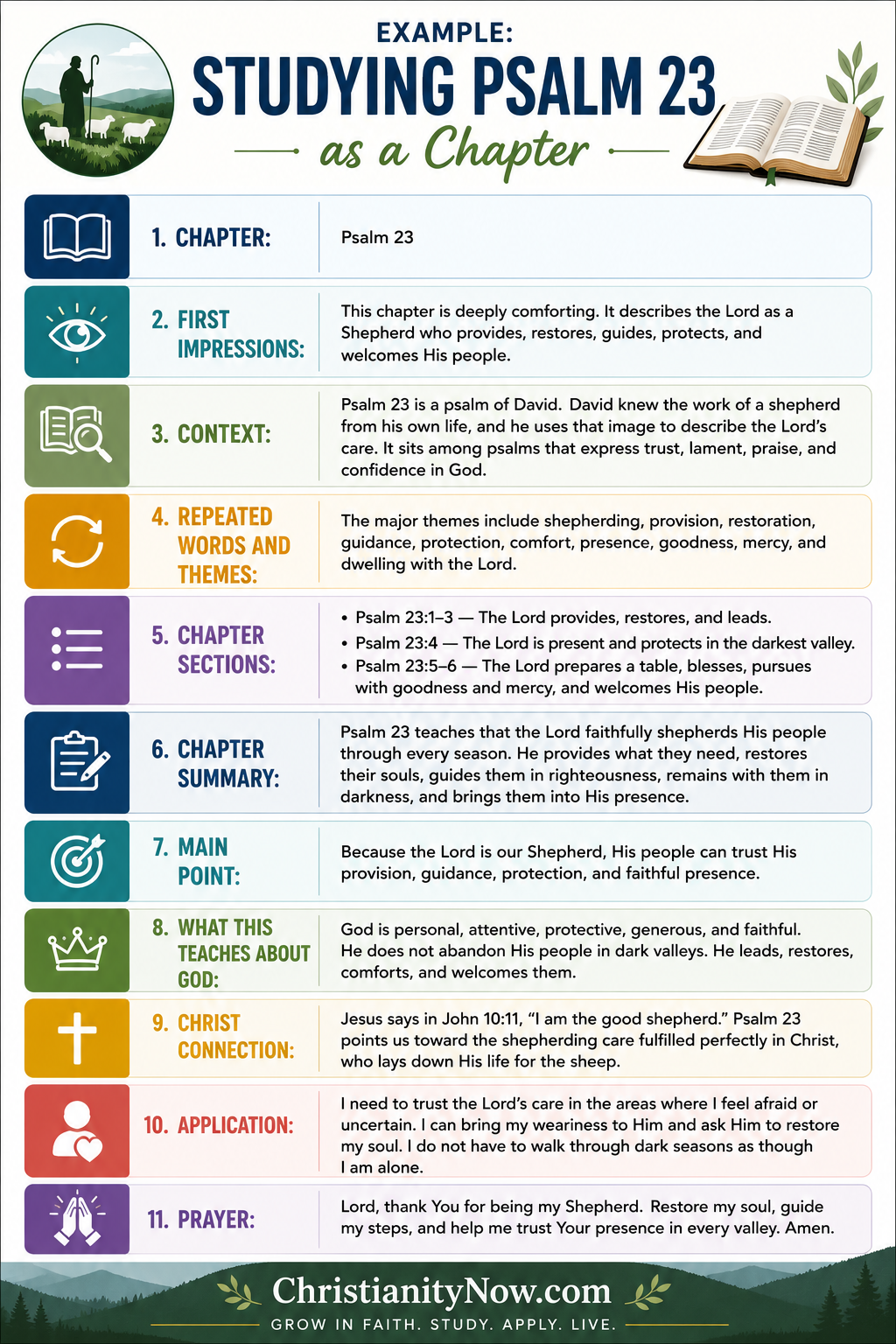
For example, a summary of Psalm 23 might be:
Psalm 23 teaches that the Lord is the faithful Shepherd of His people. He provides, restores, guides, protects, comforts, and welcomes them with goodness and mercy.
A summary of John 15 might be:
John 15 teaches that Jesus is the true vine and His disciples must abide in Him to bear fruit. The chapter calls believers to dependence, obedience, love, and faithfulness even in the face of opposition.
A summary of James 1 might be:
James 1 teaches believers how to endure trials, seek wisdom, resist temptation, and receive God’s Word with obedient faith.
Writing a summary forces you to process the chapter instead of merely reading it. It helps you clarify the main message in your own words while staying faithful to the text.
Step 7: Find the Main Point
The chapter summary describes the chapter. The main point identifies the central truth or message.
Ask: What is the main thing God is teaching in this chapter?
Sometimes the main point is a command. Sometimes it is a truth about God. Sometimes it is a warning, promise, example, or theological teaching.
For example, the main point of John 15 may be: Believers can only bear lasting fruit by abiding in Christ.
The main point of Philippians 2 may be: Christians are called to humble, self-giving love because Christ humbled Himself for us.
The main point of Psalm 1 may be: The righteous life is rooted in delighting in God’s Word, while the way of the wicked ends in judgment.
The main point should come from the chapter itself, not from an idea we bring into the chapter. This is why observation and context matter.
Step 8: Look for What the Chapter Teaches About God
The Bible is first and foremost God’s revelation of Himself. So as you study a chapter, ask what it teaches about God’s character, works, promises, commands, and ways.
Does the chapter show God as Creator, Shepherd, Father, Judge, Redeemer, King, Comforter, Deliverer, or Sustainer?
Does it reveal His holiness, mercy, justice, patience, wisdom, faithfulness, love, or power?
Does it show how God responds to sin, suffering, repentance, obedience, injustice, or faith?
For example, Psalm 23 reveals the Lord as Shepherd, Provider, Restorer, Guide, Protector, Host, and faithful Companion. Romans 8 reveals God as the One who frees believers from condemnation, gives His Spirit, adopts His people, helps them in weakness, works for their good, and keeps them in His love.
This step matters because Bible study should not become centered only on ourselves. Scripture certainly speaks to our lives, but it begins by revealing God.
When we see God more clearly, we understand ourselves more truthfully.
Step 9: Look for How the Chapter Points to Christ
Christian Bible study should ask how a passage connects to Jesus Christ and the larger story of redemption.
Some chapters point to Christ directly. John 15 records Jesus’ own words about being the true vine. Philippians 2 speaks clearly of Christ’s humility, incarnation, obedience, death, exaltation, and lordship.
Other chapters point to Christ through themes, promises, patterns, or needs. A psalm about the Lord as Shepherd points us toward Jesus, who calls Himself the good Shepherd. A chapter about sacrifice, priesthood, kingship, wisdom, deliverance, or covenant may point forward to Christ’s fulfillment.
This does not mean forcing a meaning into the chapter. It means recognizing that the Bible is one unified story centered on God’s redemption through Jesus.
Luke 24:27 tells us that Jesus explained to His disciples what was said about Him in the Scriptures. That means we should learn to read the Bible with Christ at the center.
Ask:
- Does this chapter directly mention Christ?
- Does it reveal a need only Christ can fulfill?
- Does it contain a promise, pattern, or theme fulfilled in Him?
- Does it show human sin, weakness, longing, or hope that points us to the gospel?
Seeing the Christ connection keeps Bible study from becoming only moral advice. The Bible is not merely telling us to try harder. It is revealing the Savior who rescues, restores, and reigns.
Step 10: Apply the Chapter to Daily Life
Application asks: How should this chapter shape my life?
Good application is specific. After studying the chapter, ask:
Is there a command I need to obey?
Is there a sin I need to confess?
Is there a promise I need to trust?
Is there a truth about God I need to remember?
Is there an example I should follow?
Is there a warning I should take seriously?
Is there a prayer I should pray?
Is there a habit, attitude, relationship, or decision that needs to change?
For example, if you study James 1, your application may be to ask God for wisdom in a current trial, stop blaming God for temptation, become slower to speak, or obey a truth you have been hearing but not practicing.
If you study John 15, your application may be to stop trying to bear fruit apart from Christ, return to prayer, obey Christ’s commands, or remain faithful when following Jesus brings opposition.
Application is where Bible study moves from the page into real life. James 1:22 reminds us to be doers of the Word, not hearers only.
Why Chapter Study Strengthens Bible Understanding
Chapter study strengthens Bible understanding because it teaches us to read Scripture as connected truth. Instead of collecting isolated verses, we begin seeing the message, structure, and movement of a passage.
It also helps build spiritual maturity. Serious Bible study requires patience. It asks us to slow down, ask better questions, and listen more carefully. Over time, this changes how we read Scripture.
We begin to notice repeated themes. We become more aware of context. We learn to summarize biblical truth clearly. We grow in discernment. We become less likely to misuse verses or accept shallow interpretations.
Most importantly, we learn to meet God in His Word with reverence and attention.
The Bible is not meant to be rushed past. It is meant to be received, studied, believed, and obeyed.
Reflection Questions
- Am I used to studying isolated verses, or do I regularly study full chapters?
- What Bible chapter would be a good place for me to begin this week?
- What repeated words or themes have I noticed in a chapter I recently read?
- How can studying context help me avoid misunderstanding Scripture?
- What is one truth from God’s Word that I need to apply today?
Prayer
Lord, thank You for giving us Your Word. Teach me to study Scripture with care, patience, and humility. Help me understand each chapter in context, notice repeated themes, identify the main point, and apply Your truth faithfully. Show me what each passage reveals about You, and help me see how Your Word points me to Christ. Let my study become obedience, worship, and deeper trust in You. In Jesus’ name, amen.