


Studying the Bible does not have to be complicated. For many beginners, the hardest part of Bible study is not opening the Bible. It is knowing what to do after reading a verse or passage.
You may read a chapter and wonder, “What am I supposed to notice?” You may underline a verse but still feel unsure how it connects to your daily life. You may want to pray after reading Scripture but not know how to turn what you read into a personal prayer.
That is where the SOAP Bible study method can be helpful.
SOAP is a simple Bible study method that stands for Scripture, Observation, Application, and Prayer. It gives you a clear structure for reading God’s Word, thinking carefully about what it says, applying it honestly, and responding to God in prayer.
This method is especially helpful for beginners because it is easy to remember, simple to follow, and flexible enough to use with almost any passage of Scripture. You can use SOAP during a morning quiet time, a personal devotional, a Bible study group, or a Scripture journaling routine.
Most importantly, SOAP helps us remember that Bible study is not just about gathering information. It is about meeting with God through His Word and allowing His truth to shape our lives.
What Is the SOAP Bible Study Method?
The SOAP Bible study method is a four-step way to study Scripture.
S stands for Scripture.
You begin by choosing a Bible verse or passage and writing it down.
O stands for Observation.
You look closely at what the passage says. You notice words, themes, commands, promises, warnings, and truths about God.
A stands for Application.
You ask how this Scripture should shape your life, thoughts, choices, attitude, relationships, or faith.
P stands for Prayer.
You respond to God based on what you read, asking Him to help you believe, obey, repent, trust, or worship.
The SOAP method is not meant to replace deeper Bible study. There are times when you may need to study historical context, compare translations, use cross-references, or look up biblical words. But SOAP is a wonderful starting point because it teaches the habit of reading Scripture slowly and personally.
James 1:22 says, “But be doers of the word, and not hearers only, deceiving yourselves.” SOAP helps us move from hearing the Word to responding to it.
Step 1: Scripture
The first step is Scripture. Choose a verse, a few verses, or a short passage from the Bible. Then write it down in your journal, notebook, phone, or study worksheet.
Writing the verse helps you slow down. It keeps you from rushing past the words. It also gives you time to notice details you may have missed if you only read the verse quickly.
You do not have to choose a long passage. In fact, when you are new to SOAP, it is often better to choose a shorter section. One verse can be enough if you take time to study it carefully.
For example, you might choose Philippians 4:6–7, Psalm 23:1, John 15:5, Proverbs 3:5–6, Matthew 6:33, or Romans 8:1.
The goal is not to read as much as possible. The goal is to receive what God is teaching through His Word.
When choosing your Scripture, you can follow a Bible reading plan, study through a book of the Bible, use the passage from a sermon, or select a verse you want to understand more deeply.
A simple way to begin is to read one chapter and choose one verse or short section from that chapter for your SOAP study.
Step 2: Observation
The second step is Observation. This is where you ask, “What does the passage say?”
Observation is not about personal application. Before asking what the verse means for your life, first pay attention to what is actually in the text.
Ask simple questions:
- Who is speaking?
- Who is being addressed?
- What is happening in the passage?
- Are there repeated words or ideas?
- Is there a command?
- Is there a promise?
- Is there a warning?
- Is there an example to follow or avoid?
- What does this passage teach about God?
- What does this passage teach about people?
This step matters because it protects us from making the Bible say whatever we want it to say. We want to hear God’s Word faithfully, not simply project our feelings onto the text.
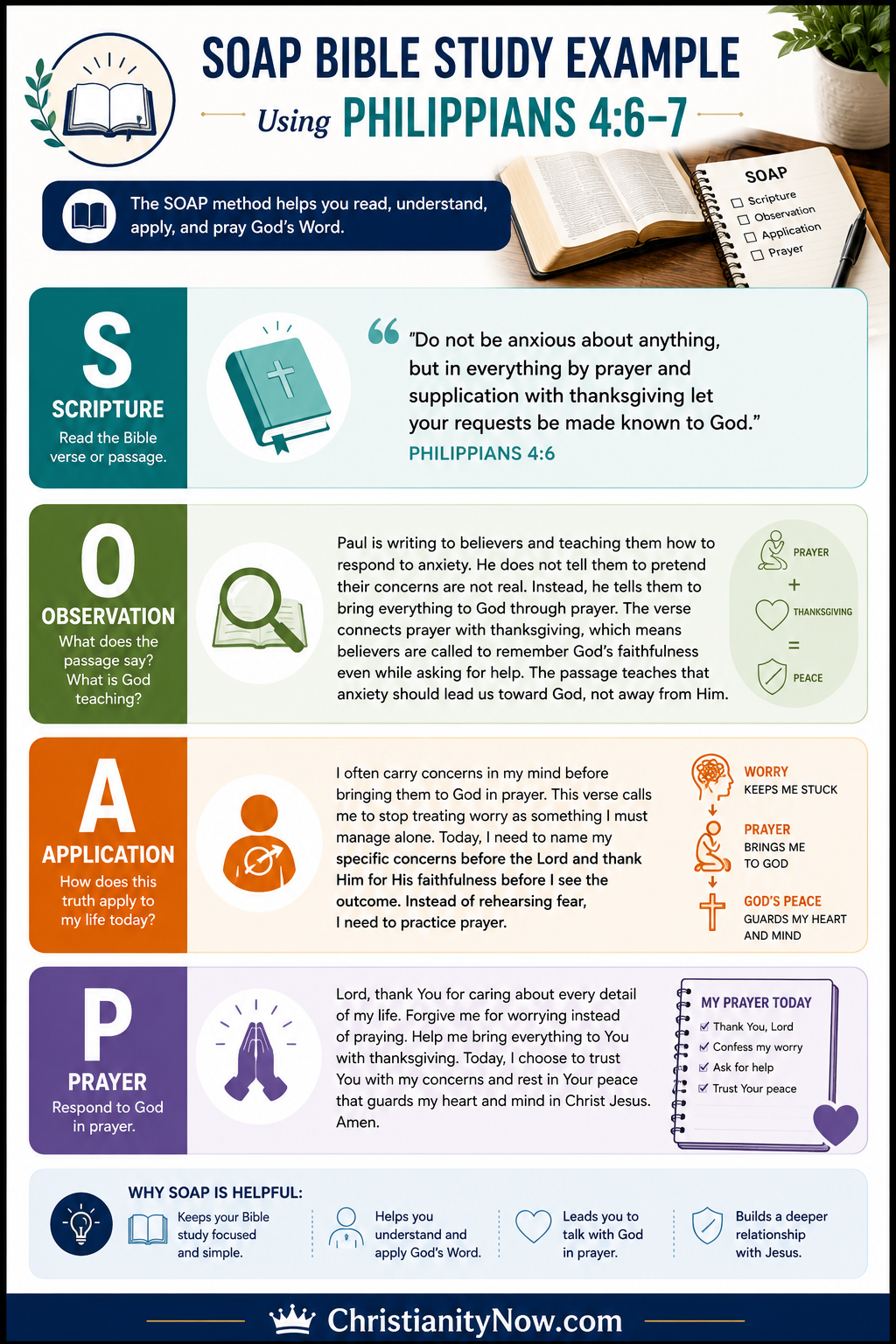
For example, if you are studying Philippians 4:6–7, you may observe that Paul tells believers not to be anxious, but to bring everything to God through prayer and thanksgiving. You may notice that prayer is connected to peace. You may also notice that the peace of God guards the heart and mind in Christ Jesus.
Observation helps you slow down enough to see the passage clearly.

Step 3: Application
The third step is Application. This is where you ask, “How should this truth shape my life?”
Application is where Bible study becomes personal. But personal does not mean we change the meaning of the verse. It means we take the meaning seriously and respond to it honestly.
Good application is specific.
Instead of writing, “I need to trust God more,” you might write, “I need to trust God with the financial worry I keep carrying alone.”
Instead of writing, “I should pray more,” you might write, “Before I react in fear today, I will stop and bring that concern to God in prayer.”
Instead of writing, “I need to love people,” you might write, “I need to forgive the person I have been avoiding and ask God to soften my heart.”
Application asks whether there is something to believe, confess, obey, surrender, change, remember, or practice.
The Bible is not meant to remain on the page. Psalm 119:105 says, “Your word is a lamp to my feet and a light to my path.” God’s Word gives light for the way we live. It speaks to our homes, work, relationships, fears, temptations, priorities, and decisions.
The SOAP Bible study method helps us ask: “Lord, what are You showing me, and how should I respond today?”
Step 4: Prayer
The final step is Prayer. After reading, observing, and applying Scripture, respond to God.
Prayer completes the SOAP method because Bible study is not merely a lesson. It is fellowship with God. We listen to Him through His Word, and we respond to Him in prayer.
Your prayer can include thanksgiving, confession, surrender, worship, or a request for help.
If the passage showed you God’s faithfulness, thank Him. If the passage revealed sin, confess it. If the passage gave a command, ask for strength to obey. If the passage reminded you of a promise, ask for faith to believe it. If the passage pointed you to Jesus, worship Him.
Your prayer does not have to sound polished. It simply needs to be honest.
A SOAP prayer might sound like this:
“Lord, I see that You are calling me to bring my worries to You instead of carrying them alone. Forgive me for letting anxiety rule my heart. Teach me to pray before I panic. Help me trust Your peace today. In Jesus’ name, amen.”
This step helps Scripture move from study into relationship. We are not only learning about God. We are talking to Him, surrendering to Him, and asking Him to form us by His Word.
When Should You Use the SOAP Method?
SOAP works well for daily devotional reading. It is especially helpful when you want to build consistency and avoid feeling overwhelmed.
You can use SOAP when reading through a Gospel, a Psalm, a chapter of Proverbs, a New Testament letter, or a short passage from the Old Testament. It is also helpful after hearing a sermon, during a small group study, or when meditating on a verse you want to memorize.
SOAP may not answer every deep question about a passage. Sometimes you will need to study context more carefully, look up historical background, or compare related Scriptures. But SOAP gives you a faithful place to begin.
Think of it as a doorway into deeper Bible study.
For beginners, the most important thing is not having the perfect system. The most important thing is learning to come to Scripture with humility, attention, and obedience.
Common Mistakes to Avoid When Using SOAP
One common mistake is rushing through the observation step. If we move too quickly to application, we may apply the verse in a way that does not match what the passage actually means.
Another mistake is making the application too vague. “Be better” or “trust God” may be true, but it helps to name a specific area where God’s Word is speaking to your life.
A third mistake is treating prayer as an afterthought. Prayer is not just the final box to complete. It is the heart’s response to God. The goal of SOAP is not simply to fill a journal. The goal is to meet with the Lord and be shaped by His truth.
Finally, do not let perfection stop you. Your SOAP notes do not need to be impressive. They do not need to sound like a sermon. They simply need to be honest and rooted in Scripture.
God is not looking for perfect journal entries. He desires a humble heart that listens and responds.
Why the SOAP Bible Study Method Helps Beginners
The SOAP Bible study method helps beginners because it gives structure without making Bible study feel impossible. It teaches four habits every believer needs: reading Scripture, observing carefully, applying truth, and praying honestly.
It helps us slow down in a distracted world. It teaches us to notice what the Bible says before rushing to conclusions. It reminds us that God’s Word is meant to shape daily life. It also helps us turn Scripture into prayer, which deepens our relationship with God.
If you have struggled to study the Bible consistently, SOAP is a simple place to begin.
Choose one passage. Write the Scripture. Observe what it says. Apply it to your life. Pray in response.
Then come back tomorrow and do it again.
Over time, this simple practice can help you grow in understanding, faith, obedience, and love for God’s Word.
Reflection Questions
- Which part of the SOAP Bible study method feels most natural to me: Scripture, Observation, Application, or Prayer?
- Which part do I need to grow in most?
- Do I tend to rush to application before observing what the passage actually says?
- What specific passage can I study using SOAP this week?
- How can I make Scripture study and prayer a more consistent part of my daily life?
Prayer
Lord, thank You for giving me Your Word. Help me use the SOAP Bible study method not as a routine to complete, but as a way to meet with You. Teach me to slow down, observe Scripture carefully, apply it honestly, and pray with faith. Let Your Word correct me, comfort me, guide me, and draw me closer to Jesus. Make me not only a reader of Scripture, but a faithful doer of Your Word. In Jesus’ name, amen.