


Verse mapping is one of the most helpful Bible study methods for people who want to slow down and understand Scripture more deeply. Instead of reading several chapters quickly, verse mapping invites you to pause over one verse, examine its words, study its context, compare it with other Scriptures, and prayerfully apply it to your life.
For many beginners, the Bible can feel overwhelming because there is so much to take in at once. There are names, places, timelines, themes, promises, commands, prophecies, parables, letters, and doctrines. Sometimes it feels like everyone else knows how to study Scripture, while you are still trying to figure out where to begin.
Verse mapping gives you a simple place to start.
It says, “Let’s take one verse. Let’s slow down. Let’s ask what this verse actually says. Let’s look at the words. Let’s understand the context. Let’s see how this truth connects to the rest of Scripture. Then let’s ask how God is calling us to respond.”
That makes verse mapping both simple and rich. It is beginner-friendly, but it can also lead to deep study. It works well for personal Bible study, journaling, small groups, devotionals, printable worksheets, and even social media graphics because it is visual and easy to organize.
Most importantly, verse mapping helps us remember that God’s Word is not meant to be rushed past. Psalm 119:18 says, “Open my eyes, that I may behold wondrous things out of your law.” Verse mapping is one way we slow down long enough to behold what God has placed in His Word.
What Is Verse Mapping?
Verse mapping is a Bible study method that helps you study one verse in detail. You write the verse down, identify key words, study the context, compare translations, look up related Scriptures, summarize the meaning, and apply the truth personally.
The goal is not to make Bible study complicated. The goal is to help you see more clearly what is already there.
A verse map usually includes:
- The verse written out
- Key words or phrases
- The surrounding context
- Definitions or word meanings
- Cross-references
- Main truth or summary
- Personal application
- Prayer response
Think of it like creating a spiritual map of one verse. You are tracing where the verse sits, what it means, what it connects to, and how it leads you toward God.
Verse mapping is especially helpful when a verse stands out to you but you want to understand it more faithfully. It helps you avoid treating Scripture like a collection of isolated quotes. Instead, you learn to read each verse within its biblical setting.
Why Verse Mapping Helps Beginners
Verse mapping helps beginners because it gives structure. Instead of asking, “What do I do with this verse?” you have a clear process to follow.
It also teaches careful reading. Many people read familiar verses so quickly that they miss the depth of what God is saying. Verse mapping slows you down and helps you notice repeated words, important phrases, commands, promises, and connections.
It also strengthens biblical understanding. When you look at the context and cross-references, you begin to see how one verse fits within the larger story of Scripture.
For example, John 3:16 is one of the most well-known verses in the Bible. But when you map it, you can study the surrounding conversation between Jesus and Nicodemus, the meaning of eternal life, the love of God, the giving of the Son, and the call to believe. A familiar verse becomes even richer when you slow down.
Verse mapping also helps with application. Instead of saying, “That was a nice verse,” you ask, “What does this teach me about God? What does this reveal about my heart? What do I need to believe, confess, obey, or remember?”
That is where Bible study becomes personal without becoming careless. The meaning of the verse does not change based on our feelings, but the truth of the verse reaches into our real lives.
Step 1: Choose One Verse
The first step in verse mapping is choosing one verse to study. You can choose a verse from your daily Bible reading, a sermon, a devotional, a Bible reading plan, or a passage that has been on your heart.
If you are new to verse mapping, begin with a verse that is clear and meaningful. Good beginner verses include:
- Proverbs 3:5–6
- John 15:5
- Romans 8:1
- Philippians 4:6–7
- Psalm 23:1
- Matthew 6:33
- Ephesians 2:8–9
- James 1:22
You do not need to choose a complicated verse. In fact, it is often better to begin with a verse that is familiar. Verse mapping can help you see familiar Scripture with fresh attention.
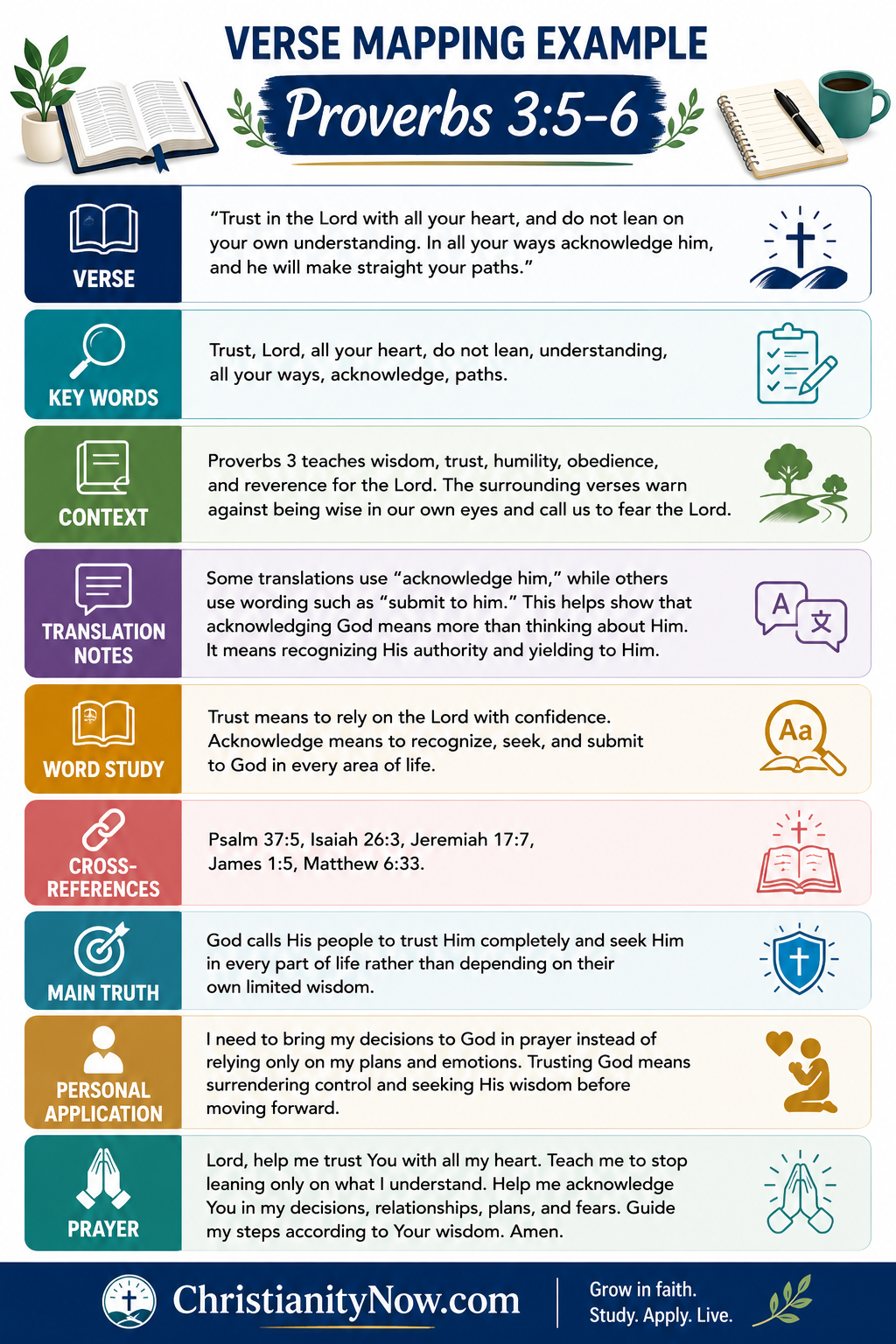
For this article, we will use Proverbs 3:5–6 as our example:
“Trust in the Lord with all your heart, and do not lean on your own understanding. In all your ways acknowledge him, and he will make straight your paths.”
This is a beautiful verse for beginners because it is practical, memorable, and deeply connected to everyday faith.
Step 2: Write the Verse Down
After choosing your verse, write it out by hand or type it into your study notes. Writing the verse helps you slow down and pay attention to each word.
For Proverbs 3:5–6, you would write:
“Trust in the Lord with all your heart, and do not lean on your own understanding. In all your ways acknowledge him, and he will make straight your paths.”
As you write, notice what stands out. Maybe the word “trust” catches your attention. Maybe the phrase “all your heart” challenges you. Maybe “your own understanding” feels personal because you are facing a decision and trying to figure everything out alone.
Writing the verse down is not just a mechanical step. It gives your mind and heart time to sit with Scripture.
Step 3: Highlight Key Words and Phrases
Next, underline or circle important words and phrases. These are the words you want to study more closely.
In Proverbs 3:5–6, key words and phrases might include:
Trust
Lord
All your heart
Do not lean
Your own understanding
All your ways
Acknowledge Him
He will make straight your paths
These words matter because they carry the weight of the verse.
“Trust” tells us what God calls us to do.
“Lord” tells us who our trust is directed toward.
“All your heart” tells us the depth of that trust.
“Do not lean on your own understanding” warns us against depending only on our limited perspective.
“In all your ways” shows that this is not only about religious moments, but all of life.
“Acknowledge Him” calls us to recognize God, submit to God, and seek God.
“He will make straight your paths” gives a promise of God’s faithful guidance.
This step helps you move from general reading to careful observation.
Step 4: Read the Context
Context is one of the most important parts of verse mapping. A verse should never be separated from the passage around it.
To study the context, read the verses before and after your chosen verse. If possible, read the whole chapter. Ask: What is happening here? Who is speaking? What is the main theme? How does this verse fit into the larger passage?
Proverbs 3 is part of wisdom instruction. It teaches the reader to value wisdom, trust the Lord, honor Him, accept His discipline, and walk in righteousness. Proverbs 3:5–6 is not a random inspirational statement. It is part of a larger call to live with reverence for God rather than self-reliance.
The surrounding verses also help us understand the meaning. Proverbs 3:7 says, “Be not wise in your own eyes; fear the Lord, and turn away from evil.” That connects directly to the warning not to lean on our own understanding. The passage is teaching humility before God.
Context helps us see that trusting the Lord is not passive. It involves reverence, surrender, obedience, and turning away from pride.
Step 5: Compare Translations
Comparing Bible translations can help you see the verse more clearly. Different faithful translations may use slightly different wording, which can highlight the meaning of a word or phrase.
For example, Proverbs 3:5–6 may be translated with phrases like “submit to him,” “acknowledge him,” or “know him” in all your ways. These wording differences invite us to ask what it means to recognize God in every part of life.
This does not mean every translation is saying something completely different. It simply helps us notice the richness of the verse.
When comparing translations, use reliable Bible translations and avoid building an entire interpretation on one unusual wording. The goal is clarity, not confusion.
A beginner might compare two or three translations. That is enough to notice helpful differences without becoming overwhelmed.
Step 6: Look Up Word Meanings
Now choose one or two key words to define more carefully. You do not need to define every word. Focus on the words that seem most important to the meaning of the verse.
In Proverbs 3:5–6, you might study “trust” and “acknowledge.”
Trust means more than agreeing that God exists. It means relying on Him, placing confidence in Him, and depending on His wisdom rather than our own limited understanding.
Acknowledge means more than briefly mentioning God. In the context of this verse, it carries the idea of recognizing Him, seeking Him, submitting to Him, and honoring Him in every path of life.
This helps us understand the verse more deeply. Proverbs 3:5–6 is not simply saying, “Believe God is there.” It is calling us to rely on the Lord completely and recognize His authority in all our decisions, desires, plans, and steps.
A Bible dictionary, study Bible, concordance, or original language tool can be helpful here. But beginners should not feel pressured to become technical scholars overnight. Start simple. Look up the word. Notice how it is used. Ask how it shapes the meaning of the verse.
Step 7: Find Cross-References
Cross-references are other Bible verses that connect to the same theme. This step helps you compare Scripture with Scripture.
For Proverbs 3:5–6, helpful cross-references might include:
Psalm 37:5: “Commit your way to the Lord; trust in him, and he will act.”
Jeremiah 17:7: “Blessed is the man who trusts in the Lord, whose trust is the Lord.”
Isaiah 26:3: “You keep him in perfect peace whose mind is stayed on you, because he trusts in you.”
James 1:5: “If any of you lacks wisdom, let him ask God.”
Matthew 6:33: “But seek first the kingdom of God and his righteousness.”
These verses help expand the theme of trust. We see that trusting the Lord includes committing our way to Him, relying on Him, seeking Him first, asking Him for wisdom, and resting our minds on Him.
Cross-references keep us from reading one verse in isolation. They help us see how the same truth appears throughout Scripture.
Step 8: Summarize the Meaning
After studying the verse, write a short summary in your own words. This helps you make sure you understand the main truth.
For Proverbs 3:5–6, your summary might be:
God calls me to trust Him completely rather than depend on my limited understanding. When I seek Him, submit to Him, and acknowledge Him in every area of life, He faithfully guides my path.
This summary does not replace the verse. It simply helps you express the meaning clearly.
Try to keep your summary faithful to the passage. Avoid making it say more than the text says. For example, Proverbs 3:5–6 does not promise that every decision will be easy, painless, or instantly clear. It promises that the Lord faithfully directs the path of those who trust and acknowledge Him.
That distinction matters.
Verse mapping should deepen our trust in Scripture, not bend Scripture around our expectations.
Step 9: Apply the Verse Personally
Application asks, “How should this truth shape my life?”
For Proverbs 3:5–6, you might ask:
- Where am I leaning on my own understanding instead of trusting God?
- What decision am I trying to control without prayer?
- What part of my life have I not fully acknowledged before the Lord?
- How can I seek God’s wisdom before taking the next step?
- What would trusting Him look like today?
A personal application might be:
I am facing a decision and trying to figure it out entirely in my own strength. This verse calls me to stop relying only on what I can see and bring the decision before God in prayer. I need to seek His wisdom, surrender my timeline, and obey what He has already made clear.
Application should be honest and specific. The more specific the application, the more likely you are to live it out.
Step 10: Respond in Prayer
The final step is prayer. After studying the verse, respond to God.
A prayer for Proverbs 3:5–6 might be:
Lord, I confess that I often lean on my own understanding. I try to control what I cannot see, and I forget that Your wisdom is greater than mine. Teach me to trust You with all my heart. Help me acknowledge You in every part of my life, not just the areas that feel easy to surrender. Guide my steps and make my path straight according to Your will. In Jesus’ name, amen.
Prayer turns verse mapping from a study exercise into a moment of communion with God. We do not only study Scripture to understand words. We study Scripture so that our hearts are shaped by God’s truth.
Common Verse Mapping Mistakes to Avoid
One common mistake is choosing too many verses at once. Verse mapping works best when you focus on one verse or a very short passage. If you try to map an entire chapter, the process can become overwhelming.
Another mistake is skipping context. A verse may sound encouraging on its own, but its full meaning becomes clearer when you read what comes before and after it.
A third mistake is making the application too general. Instead of writing, “I should trust God,” ask where you need to trust God today.
A fourth mistake is focusing more on decorating the page than studying the verse. There is nothing wrong with making a verse map beautiful, especially if you enjoy Bible journaling. But the goal is not simply to create something visually pleasing. The goal is to understand and obey God’s Word.
The best verse map is not the prettiest one. It is the one that helps you see Scripture more clearly and respond to God more faithfully.
Why Verse Mapping Can Strengthen Your Faith
Verse mapping strengthens faith because it teaches you to slow down with God’s Word. In a world full of quick quotes, short captions, and rushed opinions, verse mapping invites you to linger.
It helps you see that Scripture is deeper than a motivational phrase. Every word belongs to a context. Every verse belongs to a passage. Every passage belongs to the larger story of God’s redemption through Jesus Christ.
It also helps you become more discerning. When you learn to study verses in context, you become less likely to misuse Scripture or accept shallow interpretations. You begin to ask better questions. You begin to notice themes. You begin to see how one part of the Bible connects to another.
Most of all, verse mapping helps you approach Scripture with reverence. You are not rushing through God’s Word. You are listening.
And the more you listen, the more you learn to trust the God who speaks.
Reflection Questions
- What verse would I like to study more deeply through verse mapping?
- Do I usually read verses in context, or do I tend to focus on isolated verses?
- Which part of verse mapping would help me most right now: key words, context, cross-references, application, or prayer?
- Where am I being called to slow down and listen more carefully to God’s Word?
- How can I use verse mapping as a regular part of my Bible study routine?
Prayer
Lord, thank You for giving me Your Word. Teach me to study Scripture with patience, humility, and care. Help me notice what You have placed in each verse, understand it in context, and apply it faithfully. Keep me from rushing, assuming, or twisting Your Word to fit my own desires. Let verse mapping become a way for me to listen more deeply, trust You more fully, and walk more closely with Jesus. In His name, amen.