

Few questions matter more than this one.
People use the word salvation often, especially in church, but many do not really know what it means. Some think it means becoming a better person. Others think it means joining a religion, saying a prayer, or trying harder to live a moral life. Some hear the word and think only of heaven after death. But in Scripture, salvation is both deeper and more beautiful than many people realize.
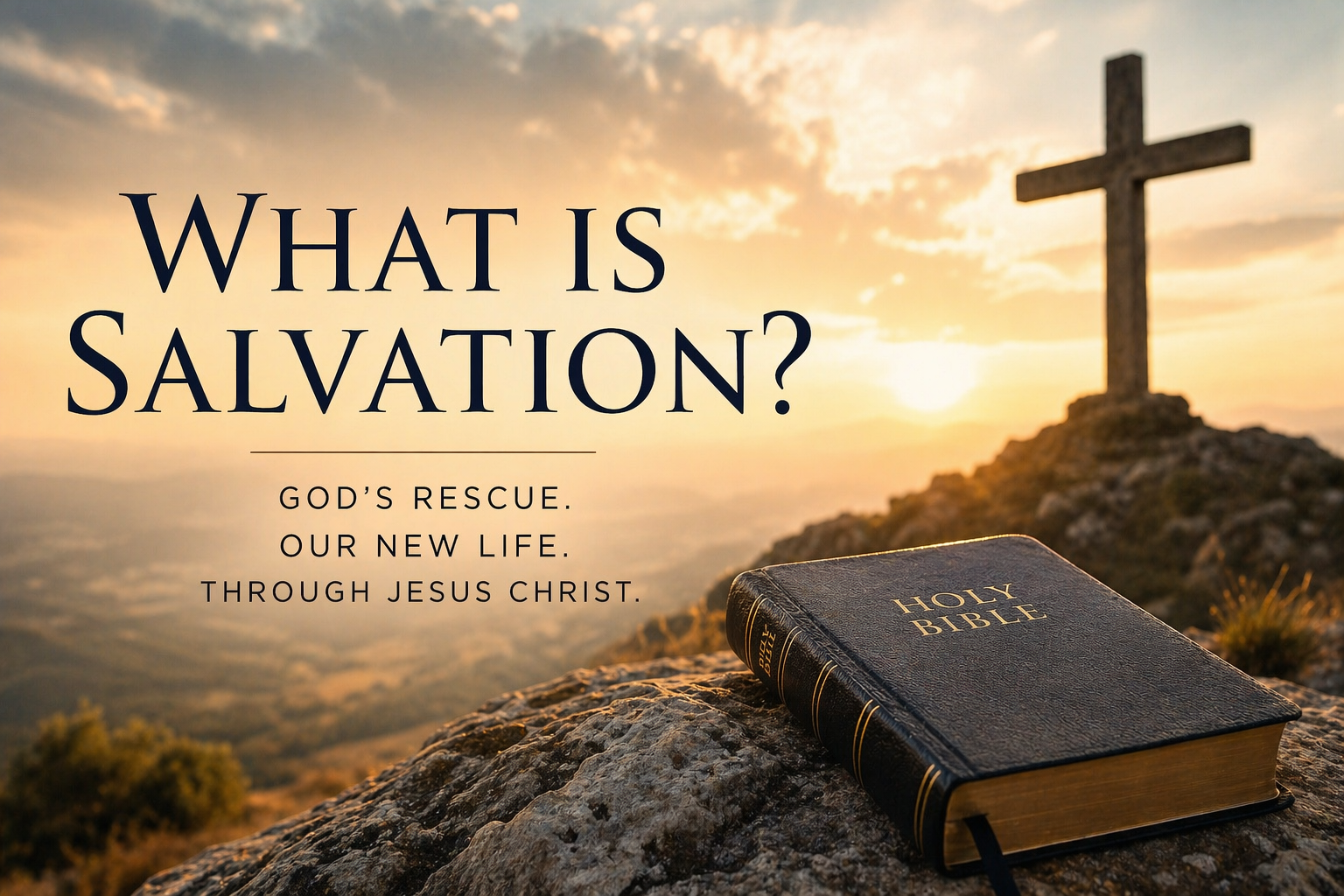
Salvation is God’s rescue of sinners through Jesus Christ.
It is His work of delivering us from sin, judgment, spiritual death, and eternal separation from Him, and bringing us into forgiveness, peace, new life, and everlasting fellowship with Himself. Salvation is not something we achieve by our own effort. It is something God gives by His grace to those who repent and believe in Jesus Christ.
To understand salvation clearly, we have to begin with what we are being saved from.
Salvation begins with the problem of sin
The Bible does not begin with human goodness. It begins with God’s holiness.
God is perfectly righteous, pure, and just. He is the Creator of all things, and everything belongs to Him. He made humanity in His image to know Him, love Him, obey Him, and reflect His glory in the world (Genesis 1:26–27). But sin entered through human rebellion, and since then every person has been marked by that fall.
Romans 3:23 says, “For all have sinned and fall short of the glory of God.” Sin is not simply a matter of mistakes, imperfections, or human weakness. It is rebellion against God. It is living outside His rule, resisting His truth, and putting self where God alone belongs. Sin corrupts the heart, distorts the mind, wounds relationships, darkens judgment, and separates people from the God who made them.
This is why salvation is so necessary. Humanity’s greatest problem isn't as simple as lack of knowledge or our weakness. Scripture says the real problem is sin, and sin leaves us guilty before a holy God.
Romans 6:23 says, “For the wages of sin is death.” That death is not only physical. It is spiritual. By nature, apart from Christ, people are dead in sin (Ephesians 2:1), under judgment (John 3:18), and unable to save themselves.
That is the bad news. And until we understand the bad news, we will never truly understand the beauty of the good news.
Salvation is rooted in the love and mercy of God
The message of salvation does not begin with man reaching up to God. It begins with God coming toward man in mercy.
God would have been just to leave humanity in its rebellion. But Scripture reveals that He is not only holy and just. He is also loving, merciful, patient, and rich in grace. John 3:16 declares, “For God so loved the world, that he gave his only Son, that whoever believes in him should not perish but have eternal life.”
That verse is familiar, but it is easy to become too familiar with it. God did not save sinners because they deserved saving. He saved because of His love and grace. Ephesians 2:4–5 says that God, “being rich in mercy,” made us alive with Christ even when we were dead in our trespasses.
Salvation, then, is not a human idea. It is God’s plan. It is His provision. It is His mercy moving toward people who could never rescue themselves.
Jesus Christ is the center of salvation
If someone asks, “What is salvation?” the clearest answer is this: salvation is found in Jesus Christ alone.
Jesus is not just a teacher, prophet, or moral example. He is the eternal Son of God who took on flesh, lived without sin, died for sinners, and rose again in victory. He did what no one else could do.
He lived the righteous life we failed to live.
He died the death we deserved to die.
He rose again so that those who trust Him might have life.
Isaiah 53 foretold that the Messiah would be pierced for our transgressions and crushed for our iniquities. In the New Testament, that prophecy finds its fulfillment in Christ. On the cross, Jesus bore the penalty of sin. He was not dying just as a martyr. He was dying as a substitute.
Second Corinthians 5:21 says, “For our sake he made him to be sin who knew no sin, so that in him we might become the righteousness of God.” First Peter 3:18 says, “Christ also suffered once for sins, the righteous for the unrighteous, that he might bring us to God.”
This is the heart of salvation. Jesus took the judgment sinners deserved so that sinners could receive the mercy He purchased.
And His resurrection matters just as much as His death. If Christ had remained in the grave, there would be no salvation. But He rose again, defeating sin, death, and hell. Because He lives, those who belong to Him have the promise of forgiveness, new life, and eternal hope.
Salvation is by grace through faith, not by works
One of the clearest truths in the Bible is that salvation cannot be earned.
This is where many people become confused. They assume salvation must be partly God and partly them. They imagine that Jesus opens the door, and then they must prove worthy enough to stay inside. But that is not the gospel.
Ephesians 2:8–9 says, “For by grace you have been saved through faith. And this is not your own doing; it is the gift of God, not a result of works, so that no one may boast.”
Grace means undeserved favor. Faith means trusting in Christ, not in yourself. Salvation is not the reward for good behavior. It is the gift God gives to those who place their trust in His Son.
That does not mean works are unimportant. Good works matter deeply, but they are the fruit of salvation, not the cause of it. A changed life does not earn salvation; it reveals that salvation has begun to take root.
Titus 3:5 says that God “saved us, not because of works done by us in righteousness, but according to his own mercy.”
That is wonderfully humbling. It means no one can boast. The moral person cannot boast. The religious person cannot boast. The churchgoing person cannot boast. All who are saved are saved the same way: by grace alone, through faith alone, in Christ alone.
Salvation calls for repentance and faith
If salvation is God’s gift, how is it received?
The Bible answers with two closely connected words: Repentance and Faith.
Repentance means turning from sin.
Faith means turning to Christ.
They are not two unrelated actions but two sides of the same response to the gospel. To repent is to renounce sin, self-rule, and unbelief. To believe is to trust Jesus Christ as Savior and Lord.
In Mark 1:15, Jesus says, “Repent and believe in the gospel.” In Acts 3:19, Peter says, “Repent therefore, and turn back, that your sins may be blotted out.”
This is important because salvation is not merely agreeing with facts about Jesus. Many people believe certain things about Jesus without actually trusting Him. Saving faith is personal. It is not just saying, “I know Jesus died.” It is saying, “My only hope before God is Jesus Christ.”
This is also why salvation is more than saying a prayer. A prayer can be a true expression of repentance and faith, and many people have genuinely called on the Lord in prayer and been saved. But words alone do not save. Christ saves. And He saves those who truly turn to Him.
Salvation is not only forgiveness. It is new life
Many people understand salvation only in terms of what they are saved from. But Scripture also speaks gloriously of what believers are saved into.
Those who are saved are forgiven. They are justified, meaning declared righteous before God because of Christ (Romans 5:1). They are adopted into God’s family (Galatians 4:4–7). They are born again by the Spirit (John 3:3–8). They are reconciled to God (Romans 5:10). They are indwelt by the Holy Spirit (Ephesians 1:13–14). They are being sanctified, which means God is actively shaping them into the likeness of Christ (2 Corinthians 3:18). And one day they will be glorified, fully transformed and forever with the Lord (Romans 8:30).
So salvation is not merely a transaction on paper. It is the beginning of a new life with God.
A saved person is not instantly perfect. Christians still struggle, still grow, still repent, and still need grace every day. But they are no longer who they once were. Their direction has changed. Their allegiance has changed. Their hope has changed.
Second Corinthians 5:17 says, “If anyone is in Christ, he is a new creation.”
That does not mean every believer’s story looks dramatic from the outside. Some conversions are sudden and visible. Others are quieter. But where salvation is real, there will be spiritual life. There will be a growing hunger for God, a new grief over sin, a desire for truth, and a life that increasingly bears the fruit of belonging to Christ.
Can you know you are saved?
For many beginners, this is the next important question.
The Bible does not call believers to live in constant uncertainty. First John 5:13 says, “I write these things to you who believe in the name of the Son of God, that you may know that you have eternal life.”
Assurance does not come from feelings alone. Feelings rise and fall. Assurance comes from trusting God’s Word, resting in Christ’s finished work, and seeing the evidence of His grace at work in your life.
If your hope is in Christ, if you have turned from sin and trusted in Him, and if there is evidence of spiritual life and desire for obedience, you do not need to live in endless fear. Salvation rests on Christ’s power to save, not on your power to hold yourself together.
Jesus said in John 10:28, “I give them eternal life, and they will never perish, and no one will snatch them out of my hand.”
What should a beginner do?
If you are asking what salvation is, do not stop at understanding the idea. Respond to the truth.
Come to Jesus Christ honestly. Confess your sin. Stop trusting in your own goodness, religion, performance, or effort. Turn to Him in repentance and faith. Ask Him for mercy. Believe that His death and resurrection are sufficient to save you. Then begin walking with Him.
Read the Bible. Pray. Join a faithful, biblically sound church. Learn the gospel deeply. Obey what God says. Grow in grace. Salvation is not the end of the Christian life. It is the beginning.
And if you already know Christ, let this truth steady you again. Your salvation is not built on your worthiness. It is built on His mercy. Not on your perfection. On His finished work.
The beauty of salvation
In the end, salvation is not mainly about escaping trouble. It is about being brought back to God.
It is the holy God making a way for guilty sinners to be forgiven, cleansed, adopted, and restored through Jesus Christ. It is judgment satisfied, mercy extended, and eternal life given. It is the dead being made alive, the lost being brought home, and the condemned being welcomed as sons and daughters.
That is why salvation is such a glorious word.
It tells the truth about our sin, but it also tells the truth about God’s grace. It humbles us, but it also fills us with hope. It shows us that we cannot save ourselves, and then it points us to the One who can.
Salvation is not found in effort, religion, or self-improvement.
Salvation is found in Jesus Christ.
And that is very good news.